You can’t trust your eyes. In fact you can’t trust any of your senses. Or even your brain.
One of the most interesting areas of scientific investigation is the study of perception. I remember that as a teenager I became moderately obsessed by visual illusions and wondering how my brain could so easily be fooled.
The image here is a good example. Which of the two horizontal lines is longest? The surprising answer, even when you know it’s true, is that both horizontal lines are exactly the same length. But that’s not what your brain tells you. Your brain demonstrates quite how easily it can be fooled when it fails to correctly interpret this sort of illusion.
There are hundreds of similar examples of such illusions, some much more complicated than this one. They all exploit the sort of perceptual mechanisms that evolved over millions of years that might have been useful in the jungle or savannah where our species originated but aren’t useful any longer in the world of newspapers, smartphones and the Internet.
The great realization is that illusions like the “Müller-Lyer illusion” shown above are just the tip of the iceberg. It’s not just our vision that can be deceived, it’s our entire brain. That’s when an illusion transforms itself into that much more dangerous animal, a delusion.
One of the most common delusions we can all easily experience is called “confirmation bias”. The Skeptic’s Dictionary describes this as “a type of selective thinking whereby one tends to notice and to look for what confirms one's beliefs, and to ignore, not look for, or undervalue the relevance of what contradicts one's beliefs.” More simply, it’s the mistake of noticing and remembering things that confirm our prejudices and ignoring, or simply not seeing the things that contradict them.
I had a conversation with someone not too long ago who suggested that religious believers are more charitable than non-believers. He seemed genuinely surprised when I pointed out that perhaps the two most charitable people in the world, Bill Gates and Warren Buffett both describe themselves as agnostics. He admitted that he knew this but had “conveniently” forgotten it. I think it’s plausible that this was because these facts didn’t fit in with his worldview. Similarly, it’s easy enough for those of us who describe ourselves as atheists to forget that the vast majority of Catholic priests, for instance, are decent people and not child abusers. We remember what we find convenient to remember, not what’s inconvenient. That’s a delusion.
Another example is homeopathy. Every piece of scientific research into homeopathy has confirmed what common sense suggests. It’s nonsense and has no effect. However there are vast numbers of people who swear by it based on anecdotes like “I had a cold, took a homeopathic remedy and within about a week I was better!”
Of course they were better. That’s how colds work, they go away after about a week or 10 days all by themselves whether you take a bogus remedy or not. People forget that but remember the time that they took the useless homeopathic remedy. Believers in so-called complimentary therapies remember the times that the delusional beliefs were falsely “confirmed”.
We also make the common mistake of assuming that correlation implies causation. Because two things happen at the same time or in parallel we assume that they must be connected and one must cause the other. A good example is the observation that increases in medical knowledge in the last century have coincided with a dramatic increase in the number of deaths from cancer. Does this mean that better medicine causes cancer? Of course not, all that’s happening is that the greater lifespan brought about by better medicine has caused people to live longer and older people are much more likely to die of cancer. Cancer is an old person’s disease. Now that we’re much less likely to die from smallpox, typhoid or violence we’re dying of different things instead.
In the same way, the assumption that more and more older people are dying of cancer is somehow caused by the new presence of cellphone masts is another delusion. There is no evidence that cellphone “radiation” causes cancer. In fact the evidence suggests that it doesn’t but it’s extremely human to notice that your aged relative died shortly after the local mast was erected and that one must have caused the other. Tragically your aged relative was going to die anyway.
The good news is that simply knowing about human psychology goes a long way towards combatting these delusions. The better we understand how our brains work (and sometimes fail) the better we can avoid dangerous delusions.
The Botswana Skeptic (or Sceptic). An unashamedly skeptical view on some of the things that affect us in Botswana. Everything written here is my opinion only, not that of any organisation to which I am connected. If I'm wrong, tell me so. If I'm right, well, you're clearly hugely clever and extraordinarily attractive.
Saturday, March 17, 2012
Saturday, March 10, 2012
Weekend Post - How good is your science and maths knowledge?
How good is your science and maths knowledge? I think the answer is simple. It’s not good enough.
There’s an online science knowledge quiz I found, hosted by the Pew Research Center, that asks visitors 12 fairly simple questions about science. None of the questions are tremendously difficult. They include questions such as “Antibiotics will kill viruses as well as bacteria. True or False?” and “Electrons are smaller than atoms. True or False?”
I know perfectly well that online surveys aren’t statistically sound, they certainly don’t represent the knowledge of the entire population but in this case I think the results tell us something. 46% of the people who completed the quiz didn’t know that antibiotics DON’T kill viruses. That’s presumably the same 46% of people who go to their doctor demanding antibiotics when they have a cold, not realizing that it will have precisely no effect.
More than half the people answering the questions did not know that electrons are smaller than atoms. Perhaps this isn’t as important as the ignorance about antibiotics and viruses but I still think it matters.
Like I said, this isn’t a representative survey of everyone in the world, just of those people who take the time to complete an American-hosted web quiz. However I suspect the results would be worse if we asked everyone else. The sort of person likely to complete the survey is someone already with access to technology, who can read English and who can understand how to click a mouse on a web page. They’re probably more science-savvy than most. It’s disappointing therefore that of all the people who completed the 12-question quiz, only 10% got every question correct.
A third of the visitors got fewer than half the questions right. The average score was between 7 and 8 out of 12 correct.
I think this is all very worrying. I’m not expecting everyone to have a comprehensive understanding of microbiology, quantum physics or stem cell research but these issues are becoming more and more important to humanity. Already we hear concerns expressed by politicians about threats of radiation from modern nuclear power stations, the perceived dangers of genetically modified foods and the risks from cellphone masts. I think the public needs to be better educated about these things so we can tell when a politician, a supposed expert or someone wanting our money makes scientific claims. We need a basic level of science knowledge to know when people talk nonsense. Like each of the three examples I gave above. All of those in fact pose no known danger but that’s not what you hear from so many so-called experts.
Of more immediate concern is our scandalously low level of mathematical understanding. I don’t know of any studies about our national levels of numeracy but the BBC recently reported on the National Numeracy campaign group in the UK. Their research showed that nearly half the working age population had numeracy skills no better than a child in primary school. They suggested that these people probably don’t even understand their own payslip at the end of the month. I don’t see a reason to suspect we’re any better in Botswana.
Chris Humphries, the chair of National Numeracy, said (and I completely agree with him):
The Chairman of the UK’s Commission for Employment and Skills, Sir Mike Rake, said:
There’s an online science knowledge quiz I found, hosted by the Pew Research Center, that asks visitors 12 fairly simple questions about science. None of the questions are tremendously difficult. They include questions such as “Antibiotics will kill viruses as well as bacteria. True or False?” and “Electrons are smaller than atoms. True or False?”
I know perfectly well that online surveys aren’t statistically sound, they certainly don’t represent the knowledge of the entire population but in this case I think the results tell us something. 46% of the people who completed the quiz didn’t know that antibiotics DON’T kill viruses. That’s presumably the same 46% of people who go to their doctor demanding antibiotics when they have a cold, not realizing that it will have precisely no effect.
More than half the people answering the questions did not know that electrons are smaller than atoms. Perhaps this isn’t as important as the ignorance about antibiotics and viruses but I still think it matters.
Like I said, this isn’t a representative survey of everyone in the world, just of those people who take the time to complete an American-hosted web quiz. However I suspect the results would be worse if we asked everyone else. The sort of person likely to complete the survey is someone already with access to technology, who can read English and who can understand how to click a mouse on a web page. They’re probably more science-savvy than most. It’s disappointing therefore that of all the people who completed the 12-question quiz, only 10% got every question correct.
A third of the visitors got fewer than half the questions right. The average score was between 7 and 8 out of 12 correct.
I think this is all very worrying. I’m not expecting everyone to have a comprehensive understanding of microbiology, quantum physics or stem cell research but these issues are becoming more and more important to humanity. Already we hear concerns expressed by politicians about threats of radiation from modern nuclear power stations, the perceived dangers of genetically modified foods and the risks from cellphone masts. I think the public needs to be better educated about these things so we can tell when a politician, a supposed expert or someone wanting our money makes scientific claims. We need a basic level of science knowledge to know when people talk nonsense. Like each of the three examples I gave above. All of those in fact pose no known danger but that’s not what you hear from so many so-called experts.
Of more immediate concern is our scandalously low level of mathematical understanding. I don’t know of any studies about our national levels of numeracy but the BBC recently reported on the National Numeracy campaign group in the UK. Their research showed that nearly half the working age population had numeracy skills no better than a child in primary school. They suggested that these people probably don’t even understand their own payslip at the end of the month. I don’t see a reason to suspect we’re any better in Botswana.
Chris Humphries, the chair of National Numeracy, said (and I completely agree with him):
“It is simply inexcusable for anyone to say ‘I can’t do maths’”.I often hear people saying that they can’t “do maths” almost as if they’re proud of it, as if it’s some sort of achievement. It’s unthinkable that someone would say that about their ability to read or write so why is it acceptable to boast of having no maths or science knowledge?
The Chairman of the UK’s Commission for Employment and Skills, Sir Mike Rake, said:
“Poor numeracy is the hidden problem that blights the UK economy and ruins individuals’ chances in life. It’s so often overshadowed by concerns about literacy, and yet there is evidence to suggest that numeracy may be an even clearer indicator of economic and personal success.”Surely the same goes for us, in both maths and science. Our success as a nation will be based on our ability to communicate and function in a modern business world. If we’re going to be a successful nation in the future we urgently need a radically revised quality of maths and science education. Failing to do this might actually be the end of us.
Sunday, March 04, 2012
Weekend Post - The threat from pseudoscience
The threat from pseudoscience isn’t just to our bank balance. It also threatens our health.
The biggest pseudoscientific health threat is probably from HIV/AIDS denialists who dare to suggest that HIV has nothing to do with AIDS and that ARVs are the agents causing illness, not curing it. Personally I’m not too worried about that in Botswana because we are one of the great ARV success stories. You can’t really argue with the effects of ARVs that we’ve probably all seen. There can’t be many people who don’t know someone whose health and quality of life have been drastically improved when they started the drugs.
Then there’s the even more dramatic influence the drugs have when given to expectant mothers. Before the PMTCT program around 40% of HIV positive pregnant mothers gave birth to HIV positive babies. After the program was introduced that figure dropped to less than one tenth of that. Each of those uninfected babies is a pretty good hint that it works.
I suspect that HIV/AIDS deniers might actually be happier if more babies died.
But not all pseudoscience is as threatening as this. What about the less harmful examples like homeopathy and reflexology?
The idea behind homeopathy is quite simple. But silly. Homeopaths will tell you that an ailment can be treated with minute quantities of substances that produce similar symptoms to those of the ailment. There is, of course, precisely no evidence that this is true. In fact the evidence shows that it’s all hogwash.
Homeopathy can’t work for a very simple reason. Homeopathic remedies contain no active ingredients. Homeopathic "remedies" are produced by repeatedly diluting a sample of the supposedly active ingredient. A homeopath might take a 1% solution of the active ingredient and dilute it repeatedly. After being diluted to 1% dilutions times it’s easy t work out that only 1 atom in every hundred billion billion will be of the so-called active ingredient. The most common forms of homeopathic remedy are actually diluted in this way thirty times, not just ten. There is simply nothing left from the original ingredient, not a single molecule.
So how do homeopaths claim it works? Apparently the water in which this ingredient once resided "remembers" that it once met the substance in question. Homeopaths talk seriously about "the molecular memory of water".
Want another absurdity? Homeopaths believe that the more diluted the liquid becomes the more effective it is. And another? The principle of homeopathic "succusion" states that the remedy becomes even more effective still if you thump it against the heel of your hand or a leather pad. I promise you I am NOT making this up.
Homeopathy is nonsense. It flies in the face of all that we have learnt over the last couple of thousand of years in the fields of chemistry, physics and biology. And common sense.
Reflexology is just as absurd.
Reflexology is based on the idea that the soles of your feet somehow map the structure of your body. A reflexologist will tell you that if she applies pressure to various spots on your feet it will somehow affect your organs. Squeeze here and your liver will be affected, tickle here and your spleen will be in top-notch shape.
This is nonsense. Every time there has been serious scientific research into reflexology it has been shown to have no more of an effect that having your feet massaged. Of course some of us might like having our feet massaged. It’s not my thing but people say it’s wonderfully relaxing and feels terrific. But that doesn’t make it medicine. It doesn’t make it true.
Both homeopathy and reflexology have been around for years but somehow manage to survive, probably because of human gullibility. But there are newcomers to the pseudoscientific family.
There are places in Gaborone where you can be plugged into an electronic device called either the QXCI, EPFX or the SCIO. This is a box of fake electronics about which some astonishing claims are made. One web site I found describes it as “an incredibly acurate (sic) biofeedback stress reduction system, combining the best of biofeedback, stress reduction, Rife machines, homeopathic medicine, bioresonance, electro-acupuncture, computer technology and quantum physics”.
Apparently it’s “multi-layer faclity enables dysfunction unravelling”. It is also “Equivalent to radonic operation”. Best of all it explains that “Most computers are binary: 1 or 0. Quantum software is trinary - basis for artificial intelligence”.
This is, of course, utter tripe.
You might wonder what “QXCI” means? It stands for “Quantum Xrroid Consciousness Interface”. Here’s your free scientific and skeptical tip for the week. Anyone who uses the word “quantum” when they are trying to sell you something is a fraud or a fool. Or both.
All of these things have one thing in common. They’re nonsense and they are all ways that frauds, charlatans and fools can take your money and keep it for themselves.
Sources
For a comprehensive summary of our success fighting HIV/AIDS see here.
If you want to know about the silliness that is homeopathy click here, here and here. For a summary of reflexology see here. For the absurd and dangerous claims made about the QXCI fraud see here.
Labels:
botswana,
botswana skeptic,
EPFX,
HIV/AIDS,
homeopathy,
Pseudoscience,
QXCI,
reflexology,
richard harriman,
scam,
scams,
SCIO
Saturday, February 25, 2012
Weekend Post - Pseudoscience
Perhaps the single biggest threat to science and the progress and benefits it offers is it’s illegitimate cousin, pseudoscience. I think it poses a greater threat than all the religious literalists, conservative denialists and political opportunists combined.
So what is pseudoscience? The simplest definition is:
A very good example is a piece of glass called the Biodisc that a company called Qnet will sell you. This really is no more than an engraved piece of glass but Qnet will have you believe that the disc “increases luminescence, designed with Biophoton production in mind”. What’s more they say the disc “can reduce water surface tension value. This in turn makes water more hydratious, which therefore improves the compatibility of water molecules with the body’s cells”.
It doesn’t take too much recollection of our school science lessons, or too much skepticism, to realize that this is utter claptrap. I’m not sure how water CAN be made “more hydratious” when that just means “watery”. Extra-watery water is an intriguing concept. However, they get away with this because many people fall for the pseudoscientific language. Referring to “surface tension”, water molecules and luminescence lends the product an air of science, if only because many of us seem to find long words impressive.
The key difference between science and pseudoscience is simple but not obvious. Scientific ideas can be disproven, pseudoscientific ones cannot. Not proven, disproven. It would be the easiest thing in the world to test the Biodisc to see if it can reduce surface tension. You and I could do that at home with a glass of water, a Biodisc and a needle. I know, I did a similar experiment with my Dad as a kid.
I admit that the Biodisc is a silly example, as well as being a silly product. It does precisely nothing so the only thing it can harm is your bank balance. The real danger is from pseudosciences that might actually have an impact on you and me or the people we care about. The father of modern scientific philosophy, Karl Popper first spotlighted Freudian psychoanalysis as a pseudoscience. All of Freud’s theories of unconscious desires, the id, ego and superego, are all based on assumptions and theories that aren’t properly testable. They can’t be disproven. So psychoanalysis isn’t scientific. It also doesn’t help that it’s hogwash.
The contrast that everyone draws is with Einstein’s theories of relativity. These theories would be very easy to disprove. They all make predictions about the behavior of light, gravity, space and time. So far every time they’ve been tested they’ve held up well under the strain. Of course one or all of them might be disproven tomorrow, it just hasn’t happened yet. It’s safe to assume for now that they’re correct.
Even worse than pseudoscience is scientific fraud. The history of science is littered with theories that have been put forward, thoroughly tested and disproven but which stick around because someone is making money out of them. Homeopathy is a good example. Homeopathic “remedies” contain no active ingredient. The pseudoscientific idea, one that has been disproven countless times, is that the water somehow remembers an ingredient it once contained but that has subsequently been diluted into nothing. It’s utter nonsense but you still see them being peddled by pharmacies all over the place.
However, at worst homeopathy is no more than a waste of money. It gets worse. There are pseudoscientific claims that kill people. For once I’ll overlook the HIV/AIDS denialists. We’re lucky enough to live in a country where I’m sure we’ve all see the impact of HIV and, just as importantly, the impact of anti-retroviral drugs. We all must have seen a relative or friend whose life has been improved almost immeasurably when they started taking ARVs.
But that’s not all, there’s also the whole “debate” about the causes of autism. There was a brief period when mercury poisoning was thought to play a role in the development of autism, particularly the mercury that was once in vaccines given to young children. This fear was based on a number of pseudoscientific ideas.
It began with the coincidence that autism often starts to develop around the time many kids get vaccinated against diseases like measles. But coincidence is not the same as causation. Kids also learn to ride bicycles at that age but nobody thought that bicycles cause autism. There is, and this is actually quite simple to understand, even for objectors to vaccination, whatever their motivation, absolutely no evidence of any relationship between childhood vaccinations and autism. None whatsoever. The effect of these denialists, using their pseudoscience, was to kill small children. After years of various countries being almost free of certain diseases, children started to die again. That’s where the danger lies. Pseudoscience kills children.
Sources
For a comprehensive overview of pseudoscience (and the definition I gave) see the Skeptic's Dictionary.
If you want a laugh take a look at the Biodisc here on the Qnet web site.
There's a comprehensive profile of Karl Popper on Wikipedia along with many links to other sites about him and his work.
For information on the absence of a link between mercury and autism see a Reuters story and a good description of the whole controversy here. Also see the Skeptic's Dictionary article here.
So what is pseudoscience? The simplest definition is:
“a set of ideas based on theories put forth as scientific when they are not scientific.”Someone using scientific sounding language but who is actually spouting scientific nonsense is talking pseudoscience.
A very good example is a piece of glass called the Biodisc that a company called Qnet will sell you. This really is no more than an engraved piece of glass but Qnet will have you believe that the disc “increases luminescence, designed with Biophoton production in mind”. What’s more they say the disc “can reduce water surface tension value. This in turn makes water more hydratious, which therefore improves the compatibility of water molecules with the body’s cells”.
It doesn’t take too much recollection of our school science lessons, or too much skepticism, to realize that this is utter claptrap. I’m not sure how water CAN be made “more hydratious” when that just means “watery”. Extra-watery water is an intriguing concept. However, they get away with this because many people fall for the pseudoscientific language. Referring to “surface tension”, water molecules and luminescence lends the product an air of science, if only because many of us seem to find long words impressive.
The key difference between science and pseudoscience is simple but not obvious. Scientific ideas can be disproven, pseudoscientific ones cannot. Not proven, disproven. It would be the easiest thing in the world to test the Biodisc to see if it can reduce surface tension. You and I could do that at home with a glass of water, a Biodisc and a needle. I know, I did a similar experiment with my Dad as a kid.
I admit that the Biodisc is a silly example, as well as being a silly product. It does precisely nothing so the only thing it can harm is your bank balance. The real danger is from pseudosciences that might actually have an impact on you and me or the people we care about. The father of modern scientific philosophy, Karl Popper first spotlighted Freudian psychoanalysis as a pseudoscience. All of Freud’s theories of unconscious desires, the id, ego and superego, are all based on assumptions and theories that aren’t properly testable. They can’t be disproven. So psychoanalysis isn’t scientific. It also doesn’t help that it’s hogwash.
The contrast that everyone draws is with Einstein’s theories of relativity. These theories would be very easy to disprove. They all make predictions about the behavior of light, gravity, space and time. So far every time they’ve been tested they’ve held up well under the strain. Of course one or all of them might be disproven tomorrow, it just hasn’t happened yet. It’s safe to assume for now that they’re correct.
Even worse than pseudoscience is scientific fraud. The history of science is littered with theories that have been put forward, thoroughly tested and disproven but which stick around because someone is making money out of them. Homeopathy is a good example. Homeopathic “remedies” contain no active ingredient. The pseudoscientific idea, one that has been disproven countless times, is that the water somehow remembers an ingredient it once contained but that has subsequently been diluted into nothing. It’s utter nonsense but you still see them being peddled by pharmacies all over the place.
However, at worst homeopathy is no more than a waste of money. It gets worse. There are pseudoscientific claims that kill people. For once I’ll overlook the HIV/AIDS denialists. We’re lucky enough to live in a country where I’m sure we’ve all see the impact of HIV and, just as importantly, the impact of anti-retroviral drugs. We all must have seen a relative or friend whose life has been improved almost immeasurably when they started taking ARVs.
But that’s not all, there’s also the whole “debate” about the causes of autism. There was a brief period when mercury poisoning was thought to play a role in the development of autism, particularly the mercury that was once in vaccines given to young children. This fear was based on a number of pseudoscientific ideas.
It began with the coincidence that autism often starts to develop around the time many kids get vaccinated against diseases like measles. But coincidence is not the same as causation. Kids also learn to ride bicycles at that age but nobody thought that bicycles cause autism. There is, and this is actually quite simple to understand, even for objectors to vaccination, whatever their motivation, absolutely no evidence of any relationship between childhood vaccinations and autism. None whatsoever. The effect of these denialists, using their pseudoscience, was to kill small children. After years of various countries being almost free of certain diseases, children started to die again. That’s where the danger lies. Pseudoscience kills children.
Sources
For a comprehensive overview of pseudoscience (and the definition I gave) see the Skeptic's Dictionary.
If you want a laugh take a look at the Biodisc here on the Qnet web site.
There's a comprehensive profile of Karl Popper on Wikipedia along with many links to other sites about him and his work.
For information on the absence of a link between mercury and autism see a Reuters story and a good description of the whole controversy here. Also see the Skeptic's Dictionary article here.
Labels:
autism,
Bio Disc,
botswana,
botswana skeptic,
homeopathy,
mercury,
Pseudoscience,
richard harriman
Saturday, February 18, 2012
Weekend Post - Why do zebras have stripes?
Why do zebras have stripes? New research suggests it might be more complicated than you think.
While it would be nice to think that zebras have stripes just so our country can have a cool national symbol I’m afraid we can be that self-centered. The zebra came first.
Let’s begin with an age-old question. Is a zebra a white horse with black stripes, or a black horse with white stripes? We now know the answer. It turns out that when they’re growing in their mother’s uterus zebras begin dark-skinned but develop white stripes before they’re born. You have to wonder why this would happen. What advantages does it offer the baby zebra to invest all that energy into growing such a complicated pattern instead of growing stronger bones, a bigger brain or stronger muscles.
Camouflage is an obvious answer. It might seem surprising to those of us who live in a country with lots of zebras but most people around the world find it shocking to think that a zebra’s stripes might offer it camouflage. How on earth, they wonder, can an animal with such a vivid pattern of such contrasting colors hide in a grey, green and brown environment? That’s until you see them in the wild and you realize that black and white merges at a distance to grey, providing excellent cover in grass, trees and bush.
Clearly that’s something that gives an individual zebra a chance at avoiding lions. Experts estimate that around 4-5 million years ago the first zebras began to appear. Presumably the first horse-like creatures with a hint of stripes must have had a slight advantage over their non-striped cousins. Critically, it must have given them a greater chance of surviving long enough to pass on their genes to their offspring. The unfortunate ones without the stripes would have been more likely to be visible in the bush and provide lions with lunch. Nature, in effect, selected the striped ones to pass on their improved genes. That’s why this type of evolution is called “natural selection”. It’s not a breeder, supernatural or not, who does the selecting, nature does it.
However, it might be a bit more complicated than just being able to hide from lions in long grass. Scientists from Sweden and Hungary recently came up with another reason why stripes might be useful. Based on some simple experiments they found evidence that stripes protect zebras from blood-sucking insects like horseflies.
They started with the knowledge that horseflies are more attracted to darker horses than to paler ones. They wondered whether stripes might somehow disrupt the attraction the dark skins held for the blood-sucking flies. That’s exactly what they found.
The researchers placed various boards of different colors and patterns in the fields surrounding a horse farm in Hungary. These boards were all covered in glue that trapped any flies that landed on them. At the end of the day the researchers just had to count the trapped flies to see which pattern attracted the most. They expected to see most flies on the darker boards, least on the palest and the stripy boards somewhere in between.
In fact they did confirm that darker boards seem to attract more flies but the surprising thing was that stripes were even less attractive to the flies than a white board. When they tried to work out which pattern of stripes were least attractive they discovered that it was exactly the pattern you find on a zebra.
So now it’s a bit more complicated. Stripes provide camouflage and enable the zebra effectively to hide from predators but they also might provide protection against bites. For this new factor to be plausible the researchers need to suggest a way in which this offers the zebras a greater chance of having babies than another that gets bitten more. The spread of disease is an obvious possibility. Fewer fly bites probably means a lower chance of fatal disease.
But there’s more than just this. Other scientists have suggested that stripes enable a herd of zebras to more effectively confuse predators and enhance their chance of escape. It’s even been suggested that the stripes are a complex form of heat regulation.
This is a great example of how evolutionary pressure is complex and often involves a wide variety of influences. It’s one of the things that makes science so wonderfully interesting. Easy, simple answers are often just too easy and too simple. Science is like the rest of life and truth. Deliciously complex.
Sources
You can see the BBC coverage of the story see here. A bit more detail can be seen at The Journal of Experimental Biology here. For a bit of background on the evolution of the horse see the Wikipedia page here. For more detail on the zebra see here.
While it would be nice to think that zebras have stripes just so our country can have a cool national symbol I’m afraid we can be that self-centered. The zebra came first.
Let’s begin with an age-old question. Is a zebra a white horse with black stripes, or a black horse with white stripes? We now know the answer. It turns out that when they’re growing in their mother’s uterus zebras begin dark-skinned but develop white stripes before they’re born. You have to wonder why this would happen. What advantages does it offer the baby zebra to invest all that energy into growing such a complicated pattern instead of growing stronger bones, a bigger brain or stronger muscles.
| Image c/o Wikipedia here: http://en.wikipedia.org/wiki/File:Zebra_camouflage.jpg |
Clearly that’s something that gives an individual zebra a chance at avoiding lions. Experts estimate that around 4-5 million years ago the first zebras began to appear. Presumably the first horse-like creatures with a hint of stripes must have had a slight advantage over their non-striped cousins. Critically, it must have given them a greater chance of surviving long enough to pass on their genes to their offspring. The unfortunate ones without the stripes would have been more likely to be visible in the bush and provide lions with lunch. Nature, in effect, selected the striped ones to pass on their improved genes. That’s why this type of evolution is called “natural selection”. It’s not a breeder, supernatural or not, who does the selecting, nature does it.
However, it might be a bit more complicated than just being able to hide from lions in long grass. Scientists from Sweden and Hungary recently came up with another reason why stripes might be useful. Based on some simple experiments they found evidence that stripes protect zebras from blood-sucking insects like horseflies.
They started with the knowledge that horseflies are more attracted to darker horses than to paler ones. They wondered whether stripes might somehow disrupt the attraction the dark skins held for the blood-sucking flies. That’s exactly what they found.
The researchers placed various boards of different colors and patterns in the fields surrounding a horse farm in Hungary. These boards were all covered in glue that trapped any flies that landed on them. At the end of the day the researchers just had to count the trapped flies to see which pattern attracted the most. They expected to see most flies on the darker boards, least on the palest and the stripy boards somewhere in between.
In fact they did confirm that darker boards seem to attract more flies but the surprising thing was that stripes were even less attractive to the flies than a white board. When they tried to work out which pattern of stripes were least attractive they discovered that it was exactly the pattern you find on a zebra.
So now it’s a bit more complicated. Stripes provide camouflage and enable the zebra effectively to hide from predators but they also might provide protection against bites. For this new factor to be plausible the researchers need to suggest a way in which this offers the zebras a greater chance of having babies than another that gets bitten more. The spread of disease is an obvious possibility. Fewer fly bites probably means a lower chance of fatal disease.
But there’s more than just this. Other scientists have suggested that stripes enable a herd of zebras to more effectively confuse predators and enhance their chance of escape. It’s even been suggested that the stripes are a complex form of heat regulation.
This is a great example of how evolutionary pressure is complex and often involves a wide variety of influences. It’s one of the things that makes science so wonderfully interesting. Easy, simple answers are often just too easy and too simple. Science is like the rest of life and truth. Deliciously complex.
Sources
You can see the BBC coverage of the story see here. A bit more detail can be seen at The Journal of Experimental Biology here. For a bit of background on the evolution of the horse see the Wikipedia page here. For more detail on the zebra see here.
Labels:
botswana,
botswana skeptic,
evolution,
richard harriman,
zebra
Saturday, February 11, 2012
Weekend Post: Good and bad news about malaria.
There’s good news and there’s bad news about malaria.
The bad news is that it’s possible we’ve ben grossly underestimating the number of deaths due to malaria over the last couple of decades. New research funded by the Bill and Melinda Gates Foundation and published in The Lancet and reported on the BBC suggests that the true death figures might be twice as high as we previously thought. For instance the World Health Organization estimated that in 2010 that 655,000 people died from malaria. The new research, which was based on a mixture of sophisticated statistical techniques and computer modeling estimated that malaria claimed 1.24 million lives around the world that year. The tragic news is that almost all of those deaths were here in Africa.
That’s the bad news.
The good news is that despite this tragic loss, the number of deaths is decreasing. While that figure is enormous, a mere six years beforehand the number was almost 2 million. The figure appears to have increased to that height in 2004 simply because there were more people living in affected areas. The subsequent drop was down to old-fashioned scientific progress.
I mean old-fashioned because it was based on theory, research and experimentation. In fact much of what was achieved was a wonderful mixture of leading edge science and some fairly old-fashioned techniques.
Not a single element of this progress was achieved using superstition, “alternative” medicine or pseudoscientific claptrap. No religion has ever saved this number of lives.
My favourite is the old-fashioned mosquito net. Nets have been used to prevent people being bitten by mosquitos for centuries. There are even stories that Cleopatra slept under one, two thousand years ago. The barrier idea is as old as the hills, just like the condom. The new element is that these nets can now be treated with a long-lasting insecticide. These insecticide treated nets, or ITNs, cost just a few US dollars and are considered by experts to be the single most effective way of preventing people getting malaria. Research has shown that they can reduce the number of episodes of malaria by up to half.
The nets don’t last forever of course and must be replaced once the insecticide has worn off but for only a few dollars a net that’s not such a huge problem, particularly when international health organisations and charities are paying for them. Better still if many people in a community use the nets the effect is to reduce the overall number of mosquitos in that area so even the neighbours who don’t have the ITNs get some benefit.
One of the interesting debates about ITNs is actually who should pay for them. Although Bill and Melinda Gates, the World Health Organisation and charities around the world are prepared to cough up the cash many experts feel that people will use the nets more if they contribute towards their cost themselves. The notion is that people feel a greater sense of emotional investment in something they’ve spent money on. A freebie is something you’ll care less about perhaps?
Almost as good, and perhaps one day even better, is the prospect of a vaccine against malaria. A couple of months ago a research scientist from GlaxoSmithKline, a drug company and therefore in many people’s minds utterly evil, announced some fantastic preliminary results. Following an 18-month clinical trial involving 15,000 African children an experimental vaccine appears to reduce the risk of contracting malaria by half.
I’m not going to defend the pharmaceutical industry against all the charges laid against it but every so often something like this comes along that is just simply good. A vaccine for malaria would be worth whatever it might cost to produce. The value in saved lives would be beyond a mere price.
Of course the real fantasy is what might happen if we can combine the treated nets AND the vaccine. Is it possible that malaria might go the way of smallpox? Until smallpox was eradicated many people thought it was an unachievable dream but science did that for us. Nobody will ever suffer from smallpox again. Maybe in our lifetimes the same can be said for malaria?
Sources
The BBC story can be seen here. A summary of the Lancet story is here.
For an overview of mosquito nets see the Wikipedia page here and for malaria see here. For the Reuters story on the GlaxoSmithKline vaccine see the story here.
Labels:
botswana,
botswana skeptic,
malaria,
richard harriman
Saturday, February 04, 2012
Weekend Post - You are what you eat
You are what you eat. Literally. Every atom of your body has come from things you have eaten or your mother ate while she was carrying you.
That’s why it important to think about the stuff you stuff down your throat. With the exception of any material your body decides not to keep and instead expels (you know what I mean) what you eat stays inside you. But you know that, we all know that. We all know that eating fairly healthily is what we should be doing. We know to cut back on the red meat, the processed foods, the saturated fats and the booze. While there’s nothing wrong with these things in moderation, the more we insert into our bodies, the more problems our bodies will have.
The danger of course is from excessive consumption of bad things. However, perhaps the worst thing you can have to excess, or even in small doses, is nutritional advice. That’s because a lot of so-called “nutritionists” are dangerous charlatans, pseudoscientific frauds or just plain fools. Many of them pose a greater risk to our health than a deep-fried double cheeseburger with extra cheese.
Which? magazine, the UK’s leading consumer advocacy publication recently did an admittedly unscientific but nevertheless fascinating and scary experiment. They sent three researchers to see a variety of nutritional “therapists” and sought advice on a range of disorders. One claimed to have fertility problems, two complained of persistent fatigue and two claimed to have a form of breast cancer.
What they should have suggested was what they should suggest for anyone, regardless of their health status. Take some exercise, eat lots of healthy food, drink lots of water and cut back on the rubbish. That sort of advice would help anyone. Even people with the illnesses described would probably have indirectly benefited from being a little bit healthier. But that’s NOT the advice the researchers were given.
Twelve of the fifteen urged the researchers to buy supplements, some costing P750 a month. They were also told not to buy them from conventional pharmacies because they weren’t “pure enough”. Instead they were advised to buy them from a particular store recommended by the quack. We can all guess why.
One of the researchers who pretended to have cancer was told to stop any conventional medical treatment and instead to beat the cancer by cutting out all sugar from her diet for three to six months. By then she might have been dead.
In fact only one of the fifteen nutritionists dispensed advice that a panel of experts described as a “borderline pass”. Eight of the fifteen cases were considered “fails” and, worst of all, six were classified as “dangerous fails”. These were situations where the client would have been at severe risk if they had followed the advice they were given.
None of the researchers were advised to consult a real doctor or to have any real tests.
The Which? report says:
Yes, of course it does, we all know it does. Part of the problem is that we have similar laws to those in the UK. Our Health Professionals Council is required to register Dieticians but not crooks calling themselves nutritionists. You or I could set ourselves up as nutritionists tomorrow. We could advertise the “Deep-fried butter and Whisky” diet, have sex with our clients and promote our own homemade supplements and nobody would have the power to stop us.
Frankly, I suspect it’s safer to eat badly than to visit a nutritionist.
Sources
The Which? article can be seen online here. There's an interesting article on science and pseudoscience in nutrition on the CSI site here.
That’s why it important to think about the stuff you stuff down your throat. With the exception of any material your body decides not to keep and instead expels (you know what I mean) what you eat stays inside you. But you know that, we all know that. We all know that eating fairly healthily is what we should be doing. We know to cut back on the red meat, the processed foods, the saturated fats and the booze. While there’s nothing wrong with these things in moderation, the more we insert into our bodies, the more problems our bodies will have.
The danger of course is from excessive consumption of bad things. However, perhaps the worst thing you can have to excess, or even in small doses, is nutritional advice. That’s because a lot of so-called “nutritionists” are dangerous charlatans, pseudoscientific frauds or just plain fools. Many of them pose a greater risk to our health than a deep-fried double cheeseburger with extra cheese.
Which? magazine, the UK’s leading consumer advocacy publication recently did an admittedly unscientific but nevertheless fascinating and scary experiment. They sent three researchers to see a variety of nutritional “therapists” and sought advice on a range of disorders. One claimed to have fertility problems, two complained of persistent fatigue and two claimed to have a form of breast cancer.
What they should have suggested was what they should suggest for anyone, regardless of their health status. Take some exercise, eat lots of healthy food, drink lots of water and cut back on the rubbish. That sort of advice would help anyone. Even people with the illnesses described would probably have indirectly benefited from being a little bit healthier. But that’s NOT the advice the researchers were given.
Twelve of the fifteen urged the researchers to buy supplements, some costing P750 a month. They were also told not to buy them from conventional pharmacies because they weren’t “pure enough”. Instead they were advised to buy them from a particular store recommended by the quack. We can all guess why.
One of the researchers who pretended to have cancer was told to stop any conventional medical treatment and instead to beat the cancer by cutting out all sugar from her diet for three to six months. By then she might have been dead.
In fact only one of the fifteen nutritionists dispensed advice that a panel of experts described as a “borderline pass”. Eight of the fifteen cases were considered “fails” and, worst of all, six were classified as “dangerous fails”. These were situations where the client would have been at severe risk if they had followed the advice they were given.
None of the researchers were advised to consult a real doctor or to have any real tests.
The Which? report says:
“One of the researchers - who had been trying to conceive unsuccessfully for over a year - was diagnosed with a ‘leathery bowel’ by a therapist who used Iridology - looking at iris patterns, colour and other characteristics of the eye to diagnose symptoms.”It goes on to say that:
“Another therapist recommended hair mineral analysis to check 'essential minerals and toxic metals', while one other 'diagnosed' a researcher as having a chromium deficiency after making him 'hold' different liquids in his mouth.”This is dangerous quackery of the worst kind. This sort of nonsense runs the real risk of killing people. But this is the UK, this sort of thing couldn’t happen here, could it?
Yes, of course it does, we all know it does. Part of the problem is that we have similar laws to those in the UK. Our Health Professionals Council is required to register Dieticians but not crooks calling themselves nutritionists. You or I could set ourselves up as nutritionists tomorrow. We could advertise the “Deep-fried butter and Whisky” diet, have sex with our clients and promote our own homemade supplements and nobody would have the power to stop us.
Frankly, I suspect it’s safer to eat badly than to visit a nutritionist.
Sources
The Which? article can be seen online here. There's an interesting article on science and pseudoscience in nutrition on the CSI site here.
Sunday, January 22, 2012
Weekend Post - How well do you know your science?
How well do you think you know basic science? Do you think you can answer the sort of questions your kids will ask you about the world?
A survey done recently in the UK by The Big Bang UK Young Scientists and Engineers Fair found that two-thirds of British parents are stumped when their kids ask them scientific questions. A quarter of them find it embarrassing that they can’t answer them. That’s particularly bad because one third of parents say their kids ask them science questions every day.
The good news is that the kids are clearly curious about science and want answers. The bad news is that most British parents can’t answer them.
So what are the questions British kids are asking their parents that are proving so difficult to answer? Here’s a sample of the most commonly asked, and least commonly answered questions. See how you do.
1. Why is the moon sometimes out in the day?
2. Why is the Sky Blue?
3. Will we ever discover aliens?
4. How much does the earth weigh?
5. How do aeroplanes stay in the air?
6. Why is water wet?
7. How do I do long division?
8. Where to birds / bees go in winter?
9. What makes a rainbow?
10. Why are there different times on earth?
Of course some of them are more difficult than others. Whether we’ll ever discover aliens is up for debate. They’re probably out there but they’re so staggeringly far away that our current understanding of physics suggests we’ll probably not make proper contact with them any day soon. And why they’d want to travel all this way to see us is arguable.
Some of the others, like why the moon is sometimes visible during the day, are fairly simple to answer and I’d be surprised if anyone had much difficulty. However some, although they are perfectly reasonable questions to ask, might challenge a lot of us a bit more. Why IS the sky blue? How DO rainbows form? Why do aeroplanes stay up in the air? With a little luck, and assuming you were paying attention that day, you might remember a few things from your school science lessons. You’ll remember forming rainbows with glass prisms in the science lab, studying the migration of birds and perhaps even a few things from geography.
One thing I found pleasing in the study was that a third of all the parents questioned said that if they didn’t know the answer to one of these questions they do some research and find it out. Particularly in these days of easy internet access it’s not difficult to find the answers for yourself. For instance if you do a Google search for “Why is the sky blue?” you’ll get 81 million hits. Of course some of them will be nonsense but the first ten were all correct and all mentioned how the different colors in white light are scattered by air molecules to different degrees, and how blue light scatters the most. The most scattered light hits our eyes from the most scattered area, leaving the other colors to travel more directly from the sun. Not only is that why the sky is blue, it’s why the sun is yellow.
If you can figure that one out, the rainbow question follows on quite nicely although this time with water droplets refracting the colors within sunlight to different degrees. Incidentally, despite what a rather aggressively religious acquaintance once told me, knowing how a rainbow is formed does NOT make it any less beautiful and impressive. In fact, I think it makes it more wonderful.
What about some bad news? Over 20% of the parents sampled said that if they didn’t know the answer to one of these questions they would either make one up or claim that nobody knew the answer.
One of the suggestions of this study is delightful. Their spokesman, Professor Brian Cox, who you may have seen presenting science programs on DSTV, said:
Sources
The web site of the The Big Bang UK Young Scientists and Engineers Fair can be seen here. You can download their press release (it's a 193k Microsoft Word document) here.
Some answers to the questions can be seen here at the following links:
1. Why is the moon sometimes out in the day? Ask NASA. They should know.
2. Why is the Sky Blue? No, it's not because God is a boy. It's because of differential scattering.
3. Will we ever discover aliens? A Russian astronomer thinks so.
4. How much does the earth weigh? A lot.
5. How do aeroplanes stay in the air? My lesson for today. I thought it was just Bernoulli's principle but it's more complicated than that.
6. Why is water wet? It's not. "Wet" is just a word we use to describe the feeling of water. Call a philosopher.
7. How do I do long division? I honestly don't know, I was sick that day at school. Honest. Answer here.
8. Where to birds / bees go in winter? Bees hibernate, with birds it's more complicated.
9. What makes a rainbow? Water droplets make rainbows.
10. Why are there different times on earth? The Earth is a sphere and it can't all point in the same direction at once.
A survey done recently in the UK by The Big Bang UK Young Scientists and Engineers Fair found that two-thirds of British parents are stumped when their kids ask them scientific questions. A quarter of them find it embarrassing that they can’t answer them. That’s particularly bad because one third of parents say their kids ask them science questions every day.
The good news is that the kids are clearly curious about science and want answers. The bad news is that most British parents can’t answer them.
So what are the questions British kids are asking their parents that are proving so difficult to answer? Here’s a sample of the most commonly asked, and least commonly answered questions. See how you do.
1. Why is the moon sometimes out in the day?
2. Why is the Sky Blue?
3. Will we ever discover aliens?
4. How much does the earth weigh?
5. How do aeroplanes stay in the air?
6. Why is water wet?
7. How do I do long division?
8. Where to birds / bees go in winter?
9. What makes a rainbow?
10. Why are there different times on earth?
Of course some of them are more difficult than others. Whether we’ll ever discover aliens is up for debate. They’re probably out there but they’re so staggeringly far away that our current understanding of physics suggests we’ll probably not make proper contact with them any day soon. And why they’d want to travel all this way to see us is arguable.
Some of the others, like why the moon is sometimes visible during the day, are fairly simple to answer and I’d be surprised if anyone had much difficulty. However some, although they are perfectly reasonable questions to ask, might challenge a lot of us a bit more. Why IS the sky blue? How DO rainbows form? Why do aeroplanes stay up in the air? With a little luck, and assuming you were paying attention that day, you might remember a few things from your school science lessons. You’ll remember forming rainbows with glass prisms in the science lab, studying the migration of birds and perhaps even a few things from geography.
One thing I found pleasing in the study was that a third of all the parents questioned said that if they didn’t know the answer to one of these questions they do some research and find it out. Particularly in these days of easy internet access it’s not difficult to find the answers for yourself. For instance if you do a Google search for “Why is the sky blue?” you’ll get 81 million hits. Of course some of them will be nonsense but the first ten were all correct and all mentioned how the different colors in white light are scattered by air molecules to different degrees, and how blue light scatters the most. The most scattered light hits our eyes from the most scattered area, leaving the other colors to travel more directly from the sun. Not only is that why the sky is blue, it’s why the sun is yellow.
If you can figure that one out, the rainbow question follows on quite nicely although this time with water droplets refracting the colors within sunlight to different degrees. Incidentally, despite what a rather aggressively religious acquaintance once told me, knowing how a rainbow is formed does NOT make it any less beautiful and impressive. In fact, I think it makes it more wonderful.
What about some bad news? Over 20% of the parents sampled said that if they didn’t know the answer to one of these questions they would either make one up or claim that nobody knew the answer.
One of the suggestions of this study is delightful. Their spokesman, Professor Brian Cox, who you may have seen presenting science programs on DSTV, said:
“the best thing parents can do is work with their children to find the answers – not only can it be fun, but you’ll both learn something new along the way.”I can’t think of anything better than finding out scientific, absolute truth with your children.
Sources
The web site of the The Big Bang UK Young Scientists and Engineers Fair can be seen here. You can download their press release (it's a 193k Microsoft Word document) here.
Some answers to the questions can be seen here at the following links:
| Photo c/o Wing-Chi Poon |
2. Why is the Sky Blue? No, it's not because God is a boy. It's because of differential scattering.
3. Will we ever discover aliens? A Russian astronomer thinks so.
4. How much does the earth weigh? A lot.
5. How do aeroplanes stay in the air? My lesson for today. I thought it was just Bernoulli's principle but it's more complicated than that.
6. Why is water wet? It's not. "Wet" is just a word we use to describe the feeling of water. Call a philosopher.
7. How do I do long division? I honestly don't know, I was sick that day at school. Honest. Answer here.
8. Where to birds / bees go in winter? Bees hibernate, with birds it's more complicated.
9. What makes a rainbow? Water droplets make rainbows.
10. Why are there different times on earth? The Earth is a sphere and it can't all point in the same direction at once.
Saturday, January 14, 2012
Weekend Post - Evolution is happening all around us, we just don’t see it.
Evolution is happening all around us, we just don’t see it.
The problem with witnessing evolution happening is that it’s slow. VERY slow. Not as slow as mountain formation and continental drift but nevertheless really, really slow.
Let’s just recap. Evolution is the slow change in form of a species over multiple generations. Each generation perhaps changes a little, tiny, almost invisible amount but after many generations a noticeable change can be seen.
The changes happen because of the way that plants and animals reproduce. Almost all of them reproduce sexually. Two parents share their genetic information to produce a child. Some of the mother’s characteristics show up in the child, some of the father’s but occasionally there’s an error in the mix and strange things emerge, some of them good, others bad. Every so often one crops up that gives the child an advantage, the sort of advantage that will improve his or her chances of reproducing and passing on that advantage to their offspring. Nature, in effect, selects that child to pass on his or her genes more than a child without the advantage. That’s what Darwin called Natural Selection.
The problem with witnessing human evolution is that most of us don’t even consider making babies for at least 20 years. Even those of us who are VERY lucky will only ever see perhaps 7 generations in our family. I for instance met my great-grandparents and with luck I might meet my own great-grandchildren but seven generations isn’t enough for any major change in form to emerge.
That’s why geneticists are forced to choose other species to examine, ones that breed much more rapidly. Their favourite is the fruit fly. That’s because they can breed only 10 days after birth, allowing dozens of generations to be examined in a year. Also, even though they have an extremely simple genetic make-up with only 4 chromosomes (humans have 23) they nevertheless share most of the genes for disease that humans possess.
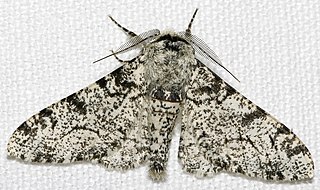
Perhaps the most famous example of evolution actually being observed was the Peppered Moth. This was a common moth in England that was normally white with black speckles but a tiny proportion were born much darker. The paler moths were clearly at an advantage when they rested on the pale, lichen-covered trees they called home and the darker ones never lasted very long before predatory birds had them for lunch.
As the Industrial Revolution began and the countryside became more and more polluted it was noticed that over many generations the moths gradually changed their coloring to match the increasingly darkened environment. Eventually 98% of the moths were born black. Clearly the moths with the paler coloring became increasingly visible to the birds that ate them and the ones who happened to be darker were more likely to avoid the birds. The darker ones passed on this genetic advantage to their children and over time almost the entire population became dark.
Rather wonderfully, when the pollution finally subsided and the environment became paler again, the moths gradually changed back to their original color. Although this wasn’t a change of species into another it certainly demonstrated that the form of a species can change remarkably rapidly when the environment demands it.
Similar effects have been seen in fish, for instance the South American guppy, again with a fairly rapid change in their camouflage. As with the Peppered Moth camouflage is a great way of staying alive, or of being eaten by a predator if it fails, before you get a chance to pass on your genes.
What about humans? Are genetic mutations going on right now that might give some people an advantage? Certainyly. There’s a town called Limone sul Garda in Italy where a small proportion of the community have a mutated version of a protein that protects them against cardiovascular disease. They’ve even been able to trace the mutation back 300 years to the original “mutant”, a man called Giovanni Pomarelli. Drug companies are doing their best to make an artificial version of the protein that you and I can take. It’s either that or we send our children to that town in Italy to make babies with Signor Pomorelli’s descendants and get the gene into our family as well.
Sources
For a good introduction to evolution see the Wikipedia page here. That page contains a summary of Natural Selection but there's a fuller description here.
If you want to know more about the fruit fly see the Wikipedia page here. For details on their disease gene similarity to humans see here.
There's a very good summary of the evolution of the Peppered Moth here. Details of the micro-evolution of the South American guppy can be seen here and a profile of the biologist concerned, John Endler here.
Finally you can see details of the fascinating advantageous mutation in Italy here and here.
The problem with witnessing evolution happening is that it’s slow. VERY slow. Not as slow as mountain formation and continental drift but nevertheless really, really slow.
Let’s just recap. Evolution is the slow change in form of a species over multiple generations. Each generation perhaps changes a little, tiny, almost invisible amount but after many generations a noticeable change can be seen.
The changes happen because of the way that plants and animals reproduce. Almost all of them reproduce sexually. Two parents share their genetic information to produce a child. Some of the mother’s characteristics show up in the child, some of the father’s but occasionally there’s an error in the mix and strange things emerge, some of them good, others bad. Every so often one crops up that gives the child an advantage, the sort of advantage that will improve his or her chances of reproducing and passing on that advantage to their offspring. Nature, in effect, selects that child to pass on his or her genes more than a child without the advantage. That’s what Darwin called Natural Selection.
The problem with witnessing human evolution is that most of us don’t even consider making babies for at least 20 years. Even those of us who are VERY lucky will only ever see perhaps 7 generations in our family. I for instance met my great-grandparents and with luck I might meet my own great-grandchildren but seven generations isn’t enough for any major change in form to emerge.
That’s why geneticists are forced to choose other species to examine, ones that breed much more rapidly. Their favourite is the fruit fly. That’s because they can breed only 10 days after birth, allowing dozens of generations to be examined in a year. Also, even though they have an extremely simple genetic make-up with only 4 chromosomes (humans have 23) they nevertheless share most of the genes for disease that humans possess.
Perhaps the most famous example of evolution actually being observed was the Peppered Moth. This was a common moth in England that was normally white with black speckles but a tiny proportion were born much darker. The paler moths were clearly at an advantage when they rested on the pale, lichen-covered trees they called home and the darker ones never lasted very long before predatory birds had them for lunch.
As the Industrial Revolution began and the countryside became more and more polluted it was noticed that over many generations the moths gradually changed their coloring to match the increasingly darkened environment. Eventually 98% of the moths were born black. Clearly the moths with the paler coloring became increasingly visible to the birds that ate them and the ones who happened to be darker were more likely to avoid the birds. The darker ones passed on this genetic advantage to their children and over time almost the entire population became dark.
| The Peppered Moth: Before (Picture taken by Olaf Leillinger) |
| The Peppered Moth: After (Picture taken by Olaf Leillinger) |
Similar effects have been seen in fish, for instance the South American guppy, again with a fairly rapid change in their camouflage. As with the Peppered Moth camouflage is a great way of staying alive, or of being eaten by a predator if it fails, before you get a chance to pass on your genes.
What about humans? Are genetic mutations going on right now that might give some people an advantage? Certainyly. There’s a town called Limone sul Garda in Italy where a small proportion of the community have a mutated version of a protein that protects them against cardiovascular disease. They’ve even been able to trace the mutation back 300 years to the original “mutant”, a man called Giovanni Pomarelli. Drug companies are doing their best to make an artificial version of the protein that you and I can take. It’s either that or we send our children to that town in Italy to make babies with Signor Pomorelli’s descendants and get the gene into our family as well.
Sources
For a good introduction to evolution see the Wikipedia page here. That page contains a summary of Natural Selection but there's a fuller description here.
If you want to know more about the fruit fly see the Wikipedia page here. For details on their disease gene similarity to humans see here.
There's a very good summary of the evolution of the Peppered Moth here. Details of the micro-evolution of the South American guppy can be seen here and a profile of the biologist concerned, John Endler here.
Finally you can see details of the fascinating advantageous mutation in Italy here and here.
Weekend Post - The New Year is a bad time for science
The New Year is a bad time for science. Part of it is the ridiculous New Years resolutions that so many of us make each year. Most of them, and I confess I’m not immune to this, involve promising yourself that you’ll live more healthily. You’ll promise to cut back on the booze, the saturated fat and the chocolate.
Unfortunately the purveyors of pseudoscience know this and shamelessly exploit our good intentions.
A few days ago I saw an advertisement on TV for the completely nonsensical “Detox Foot Pads”. According to the advert you stick these pads to the soles of your feet at bedtime and they apply warmth to your reflexology points and "detox your body while you sleep". The advert claims that this boosts your immune system. According to the personal testimonials from a range of grinning faces you wake feeling refreshed and with "less toxins and impurities".
According to the various characters presenting these pads they generate "far infra-red radiation equivalent to a full cardiac workout". The graphics they showed of two glowing feet were apparently "Thermo X-Rays" that showed "the incredible effects". Actually it looked more like a kid's drawings of feet with wobbly orange spots but maybe I'm too cynical and perhaps "Thermo X-Rays" are a bit of medical technology I've missed over the years.
Unfortunately they fail to point out that everything they say is complete rubbish.
To begin with there’s the reflexology angle. Reflexology is based on the notion that the soles of your feet are somehow connected to every other part of your body. Reflexologists will tell you that stimulation of specific spots on your feet can remedy problems in related organs of your body. However, it overlooks the fact that these connections simply don’t exist. They’re not there. Nowhere. They are as imaginary as the supposed benefits that reflexology offers. Bring me an anatomy textbook and we can fail to find these mythical connections together. There is no scientific evidence whatsoever that reflexology is anything more than just a comforting foot massage. If you like your feet massaged then good luck to you but don’t expect any medical benefits from it.
Then there’s the issue of “detoxing” through the soles of your feet. The advert shows some used foot pads and, amazingly, they are all blackened with what we are told are the toxins extracted from your feet. No chance that the dirt could just be from dirty, sweaty feet is there? Feet are actually horribly dirty things. Why do you think they smell so bad if not washed?
Then there’s the whole issue of detoxification in general. The whole detox industry is based on a series of lies and deceptions. A BBC news story a couple of weeks ago discussed this. A variety of doctors pointed out that thinking of “detoxing” your liver after the Christmas and New Year festivities was a complete waste of time. Despite the claims of the many detox remedies aggressively advertised over the break, none of them offer any real benefit. One of the doctors quoted by the BBC said:
Although detox foot pads are certainly harmless, the danger is that they could be used when real medical help is called for, not just a placebo. They also spread lies about how your body works. That can only lead to danger.
While I think that satellite TV, newspapers and the internet are wonderful things they also have the ability to spread deception, dangerous conspiracy theories and outright lies. Detox foot pads may be a relatively innocent example but they are not that far from things that threaten our welfare, maybe even our lives. Sometimes the detoxing we need is not of our bodies, but of our brains.
Sources
You can see a version of the ad I saw on DSTV here. It's a US version of the ad with US contacts and prices but you'll hear that all of the "happy customers" are South Africans.
You can see an enormous variety of critical comments about these nonsensical foot pads as follows:
The BBC story about the silliness of detoxing can be seen here.
Unfortunately the purveyors of pseudoscience know this and shamelessly exploit our good intentions.
A few days ago I saw an advertisement on TV for the completely nonsensical “Detox Foot Pads”. According to the advert you stick these pads to the soles of your feet at bedtime and they apply warmth to your reflexology points and "detox your body while you sleep". The advert claims that this boosts your immune system. According to the personal testimonials from a range of grinning faces you wake feeling refreshed and with "less toxins and impurities".
According to the various characters presenting these pads they generate "far infra-red radiation equivalent to a full cardiac workout". The graphics they showed of two glowing feet were apparently "Thermo X-Rays" that showed "the incredible effects". Actually it looked more like a kid's drawings of feet with wobbly orange spots but maybe I'm too cynical and perhaps "Thermo X-Rays" are a bit of medical technology I've missed over the years.
Unfortunately they fail to point out that everything they say is complete rubbish.
To begin with there’s the reflexology angle. Reflexology is based on the notion that the soles of your feet are somehow connected to every other part of your body. Reflexologists will tell you that stimulation of specific spots on your feet can remedy problems in related organs of your body. However, it overlooks the fact that these connections simply don’t exist. They’re not there. Nowhere. They are as imaginary as the supposed benefits that reflexology offers. Bring me an anatomy textbook and we can fail to find these mythical connections together. There is no scientific evidence whatsoever that reflexology is anything more than just a comforting foot massage. If you like your feet massaged then good luck to you but don’t expect any medical benefits from it.
Then there’s the issue of “detoxing” through the soles of your feet. The advert shows some used foot pads and, amazingly, they are all blackened with what we are told are the toxins extracted from your feet. No chance that the dirt could just be from dirty, sweaty feet is there? Feet are actually horribly dirty things. Why do you think they smell so bad if not washed?
Then there’s the whole issue of detoxification in general. The whole detox industry is based on a series of lies and deceptions. A BBC news story a couple of weeks ago discussed this. A variety of doctors pointed out that thinking of “detoxing” your liver after the Christmas and New Year festivities was a complete waste of time. Despite the claims of the many detox remedies aggressively advertised over the break, none of them offer any real benefit. One of the doctors quoted by the BBC said:
“Detoxing for just a month in January is medically futile. It can lead to a false sense of security and feeds the idea that you can abuse your liver as much as you like and then sort everything else with a quick fix.”In fact the best way to get healthy after the over-indulgence is just to stop over-indulging and to make a few simple lifestyle changes to protect your health. Your liver is a remarkable cleansing machine so long as you treat it with a little bit of respect. It will do all the detoxing you need if you let it. You don’t need silly footpads, reflexology or any other pseudoscientific claptrap to help get back to good health.
Although detox foot pads are certainly harmless, the danger is that they could be used when real medical help is called for, not just a placebo. They also spread lies about how your body works. That can only lead to danger.
While I think that satellite TV, newspapers and the internet are wonderful things they also have the ability to spread deception, dangerous conspiracy theories and outright lies. Detox foot pads may be a relatively innocent example but they are not that far from things that threaten our welfare, maybe even our lives. Sometimes the detoxing we need is not of our bodies, but of our brains.
Sources
You can see a version of the ad I saw on DSTV here. It's a US version of the ad with US contacts and prices but you'll hear that all of the "happy customers" are South Africans.
You can see an enormous variety of critical comments about these nonsensical foot pads as follows:
- Wikipedia
- Camcheck article from South Africa"
- Stephen Barrett's Device Watch
- The US Food and Drug Administration's variosu comments and rulings
- The Beauty Brains web site (they say "What a load of crap!")
The BBC story about the silliness of detoxing can be seen here.
Thursday, January 05, 2012
Weekend Post - Is this the year that the world will end?
Is this the year that the world will end? No, it isn’t and next year won’t be either.
For several years we’ve been hearing a whole lot of nonsensical speculation about 2012 being the year of the end of the world. If you do a Google search for the exact phrase “2012 end of the world” you’ll find over 18 million hits, almost all of them suggesting that this is somehow true. One of the most important things to know in the 21st century is that just because something’s on the Internet that doesn’t mean it’s true. In fact I’m tempted to suggest that if something IS widely mentioned on the Internet then it’s almost certainly rubbish. The 2012 prophecies are a fine example of that.
To begin with let’s face a simple fact. Without doubt, every single prediction of the end of the world so far has been wrong. Every one, without exception. Not once has the world ended. By this stage surely we should have cast aside end of the world predictions along with witch-burning, reading chicken entrails, astrology and homeopathy. They’ve never worked in the past, they have no rational basis and they’re just plain silly.
However, because each of these things persists those of us who believe in the power of the scientific method and reason have to confront them over and over again.
Let’s start with the main 2012 production. One of the popular things you’ll see is the idea that a Mayan calendar reaches a major turning point in 2012, often referred to as the end of a “Great Cycle”. Even if this were true does it actually mean anything? It’s no more than just the end of a calendar, no more meaningful than reaching 31st December or my birthday. The date is just arbitrary.
But this business about the end of the Great Cycle is nonsense anyway. According to the Foundation for the Advancement of Mesoamerican Studies: “there is nothing in the Maya or Aztec or ancient Mesoamerican prophecy to suggest that they prophesied a sudden or major change of any sort in 2012. The notion of a ‘Great Cycle’ coming to an end is completely a modern invention.”
So if it isn’t the Mayans predicting the Apocalypse, who is it? Ironically it’s a strange mixture of fundamentalist Christians who predict the end of the world every year, astrologers and New Age claptrap purveyors.
I’m not going to comment on the US TV and radio evangelist predictions of the Apocalypse. Instead I’ll just refer you to last year’s predictions by Harold Camping and his gullible followers who plastered billboards all over the world with detailed predictions of Judgment Day in both May and October last year. Unfortunately for them and fortunately for us we’re still here.
Astrologers have been predicting that in 2012 a “galactic alignment” promises doom for us all. However here’s another slightly inconvenient truth. This galactic alignment is a true as the end of the Mayan Grand Cycle. It’s not true. According to NASA, who should know about these things: “There are no planetary alignments in the next few decades, Earth will not cross the galactic plane in 2012, and even if these alignments were to occur, their effects on the Earth would be negligible.”
So still no evidence.
Another often-Internet-quoted belief is that there’s a mystery planet on it’s way to destroy us. Sometimes it’s just called Planet X or other times “Nibiru”. Again let me quote the people who know about these things, NASA. “Nibiru and other stories about wayward planets are an Internet hoax. There is no factual basis for these claims. If Nibiru or Planet X were real and headed for an encounter with the Earth in 2012, astronomers would have been tracking it for at least the past decade, and it would be visible by now to the naked eye. Obviously, it does not exist.”
Perhaps the biggest hurdle in getting rational people to believe that all of this is nonsense is Hollywood. Every year there’s a disaster movie that features the end of the world, caused either by something from outer space or something closer to home. We all have images in our heads from films like Armageddon, War of the Worlds, The Day After Tomorrow and 2012. Just because Hollywood has made a film about something doesn’t make it real.
I know it’s a forlorn hope but I’m an optimist. Why don’t we all be rational this year and cast aside the thoughts of supernatural doom? Let’s face the real threats like poverty, unemployment and hunger rather than made up ones?
Sources
Correction: The Google search for "2012 end of the world" now has 21 million hits.
National Geographic (who know stuff) has a very good and entertaining summary of various 2012 myths here. The excellent material from NASA (who know everything) is here. A very comprehensive response from the Foundation for the Advancement of Mesoamerican Studies (who seem to know what they're talking about) can be seen here.
Finally if you want to see a list of the "Top 10 Apocalyptic Movies" go here. Warning, some of the films are very good (I Robot, Andromeda Strain, The Terminator), others are just terrible (Armageddon, Independence Day).
Labels:
2012,
botswana,
botswana skeptic,
end of the world,
richard harriman
Saturday, December 10, 2011
Weekend post - The physics of road safety
I’m a little obsessed by road safety at the moment. This is partially because a very good friend of mine, a loving and vibrant young wife and mother, was killed a few weeks ago in a car accident. It’s also because I’m a driver. I spend up to 2 hours each weekday behind the wheel of a car, driving mainly around Gaborone. You can’t do that without spending much of the day considering matters of mental health. How did that combi driver not see me in my great big car or perhaps he just didn’t care? Why did that BX driver think it was acceptable to overtake in the face of oncoming traffic, crossing a solid white line and exceeding the speed limit? How did that person ever get a driving licence?
As well as questioning the mental health of drivers I often find myself wondering whether drivers studied any science at school. Don’t they know anything at all about physics?
Newton’s First Law of Motion says that the velocity of an object will remain constant unless a force acts upon it. The cup of tea on your desk isn’t going to move unless you pick it up. The ball you throw in the air will only change direction and speed because of air resistance and gravity. A passenger in a car will continue moving in a straight line within the car when the car hits a brick wall. If a car travelling at 60 km/h hits a solid object and suddenly stops the occupants will continue moving at 60km/h until something stops them as well. If they’re lucky it’ll be their seatbelt or an airbag that will slow them down as gradually as possible. However if they’re not stopped by something soft it’s likely to be something very hard indeed that does it. Something like the steering wheel, the windscreen or the wall the car hit after they’ve burst through the windscreen in a spray of blood and bone.
Let’s take a simple, not too scary example. Imagine a child is in the front seat of a car that’s just left your house. Let’s say it’s a perfectly average 9-year old girl who weighs 30kg. She’s not strapped in. The car is travelling slowly at only 30 km/h but collides with the back of a massive truck and stops almost instantly. Let’s say it takes a meter to come to a halt. In the 8th of a second the car takes to stop the girl becomes a flying object within the car. She’ll hit the windscreen at something close to 30 km/h with a force equivalent to a man weighing 117kg jumping on her. She’ll probably live.
The problem is that this isn’t typical. Who drives at 30 km/h? The other problem is that the amount of energy a moving object possesses is not directly related to it’s speed. The kinetic energy of an object is proportional to the square of its speed. Double the speed and you quadruple the energy. To make matters worse if you double your speed you don’t necessarily double your stopping distance. If the car driving that unrestrained little 9-year old girl hits the same truck while travelling twice as fast, at 60 km/h, it’ll probably still stop in a metre. This time she’ll hit the windscreen with a force of almost half a ton. She’ll probably die.
Let’s be completely depressing and double the speed again to 120 km/h. The same collision will hit her with a force of almost 2 tons. She won’t just die. Someone will be forced to reassemble her body so a relative can formally identify her. I know a very brave uncle who volunteered to identify the pieces of his niece’s body so his brother, the girl’s father, didn’t have to. He couldn’t bring himself to drive his car for weeks afterwards. Every time he got behind the wheel of his car he was plagued with the images from the morgue.
That’s why I lose my temper when I see loving parents driving their beautiful children to and from school each day and they allow their kids to stand up on the front passenger’s seat. I get even madder when I see an unbelted adult in that seat with a kid on their lap. You know what? It might not just be the windscreen that kills her, it’ll be your body hitting her from behind, crushing her from front and back. Could you live with the knowledge that your body, perhaps the body that brought that child into the world, is the thing that crushed her to death?
Maybe that’s what we need to teach in physics classes in schools. Instead of balls hitting each other or weights going up and down inclines we should use the idea of a little girl inside a metal box being driven by a psychopath. Maybe that’s the sort of science we need to cut down the slaughter on our roads.
Sources
For a quick summary of Newton's Laws of Motion see the Wikipedia page here. There's also a good explanation of the physics of car crashes here.
I'd like to say that I did all the maths in this piece myself but that would be lying. I did SOME of it myself but then was lazy and used the online car crash impact calculator here.
Labels:
botswana,
botswana skeptic,
motion,
newton,
richard harriman
Saturday, December 03, 2011
Weekend Post - Is my laptop frying my fertility?”
The answer is almost certainly not but from the recent press coverage you can be forgiven for thinking otherwise.
The BBC published a story that was widely circulated that was headlined “Scientists question if wi-fi laptops can damage sperm”. The story reported that after being placed next to a laptop that was downloading data “sperm were less able to swim and had changes in the genetic code that they carry.”
Needless to say the headlines grew more and more scary as the story spread around the world’s media. The particularly hysterical British Daily Mail stated that “Radiation from WiFi connections can reduce sperm activity in up to a quarter of men” and the even more hysterical Huffington Post stated that “Wi-Fi Laptops 'Kill' Sperm”.
Unfortunately not all of the reports actually explained what the experiment involved and gave ment enough information on what to do with their laptops (and their laps).
The facts are a bit less scary that the excitable elements of the press suggest. To begin with this was just what the researchers called a “Prospective in vitro study”. This was just an experiment they conducted in a laboratory, “in vitro”, in glass. The experiment was actually very simple. Samples of healthy sperm were placed for four hours next to a laptop computer that was downloading data. Another set of samples was placed in an identical setting except there was no laptop downloading next to it. When they examined the samples after the four hours they discovered that the samples near the downloading laptop were less mobile and more damaged than the control group.
This was hardly real life. It’s certainly not what most men do with their sperm. Nevertheless it’s still an interesting study that it would be foolish to ignore. As the researchers say, “Further in vitro and in vivo studies are needed” to establish whether this effect is genuine. An “in vivo” study means a test in real life, in a living body. If other researchers can replicate these results an experiment with real men and laptops can be undertaken.
Until then we can be cautious. The most important thing is not to panic. The experiment these guys undertook is nothing like the normal way that men and women make babies. It’s also certainly not the way men usually offer their contribution to the baby-making process.
This was just one study, with a very small sample size, involving only 29 sperm samples and the effect was small. There is also no plausible explanation for how this effect might have been caused by the wi-fi network. The strength of a wi-fi signal is so weak that it’s unclear how it might have caused the damage. Critically wi-fi signals, like cellphone signals are non-ionizing, they simply don’t have the strength or frequency to cause damage to biological cells. They’re not like X-Rays or gamma rays that can have a massive impact on the human body. They’re not very different to sitting still while listening to the radio. The signals from your local radio station are around us all the time and nobody panics about them, do they?
However one thing that is known to affect sperm is heat. Excess heat around those parts of a man’s body can reduce fertility but the researchers in this study apparently ruled that out as an explanation. I’d find it perfectly easy to believe that repeatedly resting a laptop on your lap for a long period could effect a man’s fertility. Also sperm are fairly fragile and can quite easily be affected by a range of factors other than heat.
The BBC asked an expert, Dr Allan Pacey, senior lecturer in andrology at the University of Sheffield, for his reaction to the study. He said that “we cannot infer from this study that because a man might use a laptop with wi-fi on his lap for more than four hours then his sperm will necessarily be damaged and he will be less fertile.” That sounds sensible to me. Let’s wait and see what further studies come up with before banning wi-fi networks from anywhere near prospective fathers.
In the meantime, if you’re a guy worried about his fertility then not keeping a hot laptop on your lap for too long is probably very good advice. More importantly it’s hardly the way to woo your partner, is it? Better still, try some romance, you’re much more likely to make a baby that way, it’s scientifically proven. Trust me.
Sources
The original story from the BBC can be seen here and the abstract of the study can be seen on the Fertility and Sterility site here.
For the more hysterical coverage see the Daily Mail here ("Working on a laptop wirelessly may hamper a man’s chances of fatherhood") and the Huffington Post here ("Wi-Fi Laptops 'Kill' Sperm").
For more reasoned coverage see The Register here and Time here.
Labels:
botswana,
botswana skeptic,
laptops,
richard harriman,
sperm
Killer bananas
It’s a fantastic plot for a science fiction, don’t you think? “Revenge of the killer bananas!” However if you believe some people the risk is real.
Like many others I received an email a few days ago that began:
“Do not eat bananas until further notice. PNP will investigate if there is any truth in this, but rather be safe.”
The email then explained the danger posed by these homicidal fruit.
Are you feeling scared yet? Or just skeptical?
To begin with there’s a minor technicality. The FDA is a US body, not South African. Then there’s the “science” part of it. Let’s be honest about one thing. You do NOT want to develop necrotizing fasciitis. It’s a horrible bacterial infection that causes massive irreversible tissue damage and often results in either amputation of the infected body part or death. If you want to see some scary pictures do a web search but don’t do this while eating. However, can you actually catch necrotizing fasciitis from the skin of a banana?
No. The Centre for Disease Control in the USA says that there “is no evidence that necrotizing fasciitis is transmitted by food. The bacteria which most commonly cause necrotizing fasciitis live in the human body. The usual route of transmission for these bacteria is from person to person.” There is also little sense in the statement about the “disease has been able to graft itself to the skin of fruits”.
This story is a hoax. In fact it’s a very old hoax. This has been circulating around the internet for at least 12 years. It was first seen in 1999 but with a slight difference. That time it mentioned Costa Rica, not South Africa but the words in the email were otherwise exactly the same.
You can rest assured that eating bananas is still safe and they’re still good for you. You’re not going to be turned into a zombie by eating them.
However, what I find just as interesting is why people continue to send these emails. I know of several people who’ve received it and a couple who forwarded it to others. I know of one person who even posted it on Facebook. I’m sure all of these people were perfectly well-meaning and genuinely felt it was important to warn their friends about a possible risk but did they really believe the story or were they so shocked and horrified that they felt it was an emergency?
Or are they perhaps just a bit more suggestible than others? A bit less naturally skeptical? Psychologists have certainly identified that there is a scale of suggestibility with some people being more prone than others to believe what they see and hear. They are much more susceptible to suggestion, particularly with things like hypnosis but I suspect they’re just as susceptible with anything new, like emails about bananas.
I sometimes think that I’ve become overly skeptical at times, automatically assuming that something is not true until it’s proven to be so, But then I remind myself that I think this is by far the safest approach to take to life. Isn’t it better to assume what scientists call the “null hypothesis”, that something is NOT true until there’s a good reason to change your mind? That certainly goes for anything you receive in your email inbox and anything that makes remarkable claims. Sa Carl Sagan said, “remarkable claims require remarkable evidence”. There’s nothing remarkable about the killer bananas story other than the fact that people believe it.
Sources
Snopes has a report of the original hoax email that referred to Costa Rica here. There are several useful links at the end of the article. The Skeptic Detective has a comprehensive piece on the hoax here.
The official Centre for Disease Control statement can be seen here and there's a very assertive statement from the Kwa-Zulu Natal Banana Association (I SO want to join!) here.
If you're feeling brave and want to learn more about necrotizing fasciltis you can see the Wikipedia page here which includes a fascinating but ghastly fact about the death of King Herod.
The full text of the email I received is as follows:
Like many others I received an email a few days ago that began:
“Do not eat bananas until further notice. PNP will investigate if there is any truth in this, but rather be safe.”
The email then explained the danger posed by these homicidal fruit.
“Please don't eat bananas for the next 3 weeks. Several deliveries of bananas from Uvongo Kwa-Zulu Natal South Africa have been infected with necrotizing fasciitis, otherwise known as flesh eating bacteria. Recently this disease has decimated the monkey population in the south coast. We are now just learning that the disease has been able to graft itself to the skin of fruits in the region, most notably the banana which is one of South Africa’s largest exports. Until this finding scientists were not sure how the infection was being transmitted. It is advised not to purchase bananas for the next three weeks!!!”The email continued to explain how the FDA hasn’t issued a warning because it fears “a nationwide panic”. It also said that if you have an infected wound and are far from medical attention “burning the flesh ahead of the infected area is advised to help slow the spread of the infection.”
Are you feeling scared yet? Or just skeptical?
To begin with there’s a minor technicality. The FDA is a US body, not South African. Then there’s the “science” part of it. Let’s be honest about one thing. You do NOT want to develop necrotizing fasciitis. It’s a horrible bacterial infection that causes massive irreversible tissue damage and often results in either amputation of the infected body part or death. If you want to see some scary pictures do a web search but don’t do this while eating. However, can you actually catch necrotizing fasciitis from the skin of a banana?
No. The Centre for Disease Control in the USA says that there “is no evidence that necrotizing fasciitis is transmitted by food. The bacteria which most commonly cause necrotizing fasciitis live in the human body. The usual route of transmission for these bacteria is from person to person.” There is also little sense in the statement about the “disease has been able to graft itself to the skin of fruits”.
This story is a hoax. In fact it’s a very old hoax. This has been circulating around the internet for at least 12 years. It was first seen in 1999 but with a slight difference. That time it mentioned Costa Rica, not South Africa but the words in the email were otherwise exactly the same.
You can rest assured that eating bananas is still safe and they’re still good for you. You’re not going to be turned into a zombie by eating them.
However, what I find just as interesting is why people continue to send these emails. I know of several people who’ve received it and a couple who forwarded it to others. I know of one person who even posted it on Facebook. I’m sure all of these people were perfectly well-meaning and genuinely felt it was important to warn their friends about a possible risk but did they really believe the story or were they so shocked and horrified that they felt it was an emergency?
Or are they perhaps just a bit more suggestible than others? A bit less naturally skeptical? Psychologists have certainly identified that there is a scale of suggestibility with some people being more prone than others to believe what they see and hear. They are much more susceptible to suggestion, particularly with things like hypnosis but I suspect they’re just as susceptible with anything new, like emails about bananas.
I sometimes think that I’ve become overly skeptical at times, automatically assuming that something is not true until it’s proven to be so, But then I remind myself that I think this is by far the safest approach to take to life. Isn’t it better to assume what scientists call the “null hypothesis”, that something is NOT true until there’s a good reason to change your mind? That certainly goes for anything you receive in your email inbox and anything that makes remarkable claims. Sa Carl Sagan said, “remarkable claims require remarkable evidence”. There’s nothing remarkable about the killer bananas story other than the fact that people believe it.
Sources
Snopes has a report of the original hoax email that referred to Costa Rica here. There are several useful links at the end of the article. The Skeptic Detective has a comprehensive piece on the hoax here.
The official Centre for Disease Control statement can be seen here and there's a very assertive statement from the Kwa-Zulu Natal Banana Association (I SO want to join!) here.
If you're feeling brave and want to learn more about necrotizing fasciltis you can see the Wikipedia page here which includes a fascinating but ghastly fact about the death of King Herod.
The full text of the email I received is as follows:
"Please don't eat bananas for the next 3 weeks
Several deliveries of bananas from Uvongo Kwa-Zulu Natal South Africa have been infected with necrotizing fasciitis, otherwise known as flesh eating bacteria. Recently this disease has decimated the monkey population in the south coast. We are now just learning that the disease has been able to graft itself to the skin of fruits in the region, most notably the banana which is one of south africa ’s largest exports. Until this finding scientists were not sure how the infection was being transmitted. It is advised not to purchase bananas for the next three weeks!!! If you have eaten a banana in the last 2-3 days and come down with a fever followed by a skin infection seek MEDICAL ATTENTION!!!The skin infection from necrotizing fasciitis is very painful and eats two to three centimeters of flesh per hour. Amputation is likely, death is possible.. If you are more than an hour from a medical center burning the flesh ahead of the infected area is advised to help slow the spread of the infection. The FDA has been reluctant to issue a country wide warning because of fear of a nationwide panic. They have secretly admitted that they feel upwards of 15,000 South Africans will be affected by this but that these are" Acceptable numbers". Please forward this to as many of people you care about as possible as we do not feel 15,000 people is an acceptable number."
Thursday, December 01, 2011
Saturday, November 19, 2011
Weekend Post - What do modern medicine, flu, ice cream and pirates have in common?
Here are some dangerous but factual observations.
Since the introduction of modern healthcare in Botswana more people than ever before have died of cancer. People suffer from more infectious diseases in colder seasons. The more ice cream that is consumed, the higher the number of drownings that occur. The reduction in the number of pirates (yes, I said pirates) in the world has coincided with gradually increasing global temperatures.
All of these are facts, there is overwhelming evidence to support them. But the big question is what they actually mean. Is it true that modern healthcare causes cancer? Does cold weather cause colds and flu? Does ice cream cause people to drown? Has the loss of pirates actually caused global warming? Should any of us actually do anything, should we take any lifestyle decisions based on these undeniable facts?
Of course not, but that’s where the danger lies. You only have to hear of these facts for a chill to go through you. It’s only one step further before you begin to suspect the benefits of modern medicine and science.
The real facts are simple. More people are dying of cancer since the introduction of modern, scientifically based medicine because we’re living longer. Cancer is largely a disease of older people. As we’ve done away with so many of the causes of death from the past that killed younger people like infectious disease and starvation other causes of death have stepped in to fill the void. Like cancer.
People suffer more colds and flu in the winter, not because our immune systems are weaker in the cold months or because viruses are stronger but simply because when we’re cold we stay inside much more. When we’re stuck inside our homes with our families we’re much more likely to spread infections by close-proximity coughs and sneezes.
The really good news is that ice cream doesn’t make you more likely to drown. However, both rates of drowning and consumption of ice cream are both associated with hot weather. Both are caused by something else.
One of the easiest mistakes to make when looking at the world is to assume that correlation implies causation. Because two observations are somehow related then one must have caused the other. It’s a fundamental mistake and one of many logical fallacies that people often make.
A recent example. A couple of weeks ago the BBC reported that scientists had announced in the British Medical Journal “a link” between use of the oral contraceptive pill and prostate cancer. The interesting thing is that only women take the pill and only men get prostate cancer so how can one possibly cause the other? The suggestion is that the hormone oestrogen in the contraceptive pill may be released in the urine of pill-taking women into the water supply. Men then drink the water and experience one of the side-effects of oestrogen: higher rates of cancer. The team of researchers from Canada had carefully examined various countries that used of different forms of contraception and found higher levels of prostate cancer in those countries where the pill was widely used. In countries where other forms of contraception were widespread the higher levels of cancer couldn’t be found.
However they were very careful to say that their study “has significant limitations with respect to causal inference”. In other words they are most certainly NOT saying that the pill increases the risk of prostate cancer. This was just what they call “an ecological study”. They observed a correlation between two things and said that “it must be considered hypothesis generating, and thought provoking”. This wasn’t an experiment, it was just some careful observations that make scientists want to ponder a bit and then design more detailed studies.
One problem is that it’s very difficult to design an experiment to test this. If we suspect there’s a link between oestrogen and prostate cancer we can’t just expose a group of men to oestrogen and see if they develop cancer, that would be inhumane. However it would be worth conducting animal tests and further ecological studies. For instance, does the rate of prostate cancer go down in countries where the use of the pill declines or where lower oestrogen pills are used?
Finally, in case you were worried, nobody really believes there’s a relationship between the number of pirates and global warming. However if you’re willing to suspend your skeptical faculties you can join the Church of the Flying Spaghetti Monster for whom this is a core belief. Perhaps not entirely seriously!
Sources
For various sources on "Correlation Does Not Imply Causation" see the Skeptics Dictionary chapter here (180kb pdf download) or the Wikipedia page here. There's also a comprehensive list of the many logical fallacies courtesy of the Skeptic's Guide to the Universe here.
The story from the BBC about the pill and prostate cancer can be seen here and the original article in the British Medical Journal here.
For the Church of the Flying Spaghetti Monster just say "Arrrgh".
Monday, November 14, 2011
Weekend Post - We're still alive!
The world narrowly avoided destruction yet again last week.
Asteroid 2005 YU55 sped past the earth at nearly 50,000 km/h coming so close that it was within the orbit of the Moon. Although this wasn’t the biggest of objects flying through space it was big enough. Astronomers estimate it was about 400m wide, roughly spherical and something that size hitting the Earth would have caused devastation. I’m no expert but a little maths suggests that it might easily have a mass of many millions of tonnes and people have estimated that impact may have exceeded the effect of any atomic bomb ever constructed.
You might think that given that 70% of the Earth’s surface is covered in water it probably would have landed there and just made a bit of a splash but that might have actually been as bad or worse than hitting land. The tsunami that followed would have been devastating.
However this was never going to happen anyway. NASA and other agencies had been tracking it for long enough to know that it would sail right passed the Earth and would hardly been noticed. If the boffins at the various space agencies hadn’t spotted it we never would have known it was there.
Of course that didn’t stop the usual suspects claiming that this was the end of the world, many of them probably the same people who predicted the end of the world on October 21st. A variety of conspiracy theorists with too much time on their hands also started spreading rumours that there was a government cover-up of the impending doom. They’ve all been proved wrong by events as well as the science.
However we have to face the fact that sooner or later an asteroid like this IS going to hit us. It’s certainly happened before. Although it’s widely thought that an asteroid impact 65 million years ago killed off the dinosaurs there’s no conclusive proof that this was the case, it’s just one of various theories. However it’s a persuasive one. Such an impact would certainly have had a devastating effect on the planet, throwing up a global dust cloud that would have prevented sunlight getting through to the plants that feed the entire food chain. Geologists have found a layer in sedimentary rock all over the world that they call the K-T boundary. This layer contains massive amounts of iridium, and element found often in asteroids. Below the K-T boundary fossils of dinosaurs are found, above the layer they’re mostly absent which suggests whatever caused the increase in iridium in the atmosphere might be connected with dinosaur extinction. Another theory observes that iridium can also be found in the Earth’s core and a massive upsurge in volcanic activity might have been the cause. At the very least the impact of that and other asteroids certainly had a dramatic effect on the Earth and it’s not something anyone wants to happen again. But it will.
Incidentally, our recent fly-by visitor, Asteroid 2005 YU55, probably wasn’t actually big enough to cause an extinction event. We’d need to have a cosmic punch-up with something a lot bigger for that to happen.
The good news is that scientists at NASA reckon they’ve now detected almost all of the asteroids that pose a threat to the Earth and there is no evidence that any of them are coming close enough for us to worry. However, they’ve adopted the “hope for the best, plan for the worst” approach. A variety of techniques have been discussed for nudging any potentially threatening asteroid off course so that it gives the Earth a miss. They’ve considered atomic weapons, ion beams and even just throwing large rocks at it. Anything just to give it enough of a nudge to bypass us.
While the threat is real and the possible effect is devastating, the chance of it actually happening in our lifetime, or that of anyone we can imagine, is so vanishingly small that it’s not worth losing any sleep. Better still to spent our time and resources fighting the things that DO threaten us, like global warming, population growth or our species’ innate ability to kill itself with the slightest provocation. Those are things worth worrying about and worth paying scientists to find solutions for.
Sources
Start with a BBC story on the asteroid passing by. Also the Washington Post covered it here.
As always with astronomical news stories you should always consult Phil Plait, the Bad Astronomer. His comments on Asteroid 2005 YU55 are here. He also has a good animation from NASA JPL that shows the passage of the asteroid.
For some of the doom and conspiracy lunacy surrounding the asteroid see here and here.
The Washington Post discusses the efforts to detect all potentially risky asteroids here. For ideas on how to deflect asteroids heading our way the Wikipedia page summarises them well.
Wikipedia also has pages on asteroid impact events and the K-T boundary including some fantastic pictures of the boundary itself.
Sunday, November 06, 2011
Weekend Post - Was Einstein right all along?
In September there was a big fuss, reported all over the world, about an experiment conducted in Italy that suggested that Albert Einstein, his Special Theory of Relativity and his notion that nothing can travel faster than light might be wrong.
Almost every newspaper in the world asked “Was Einstein wrong?” The Italian scientists claimed that they had managed to force a beam of neutrinos to travel faster than the speed of light. Admittedly only very slightly faster than light, but even a little bit would have been enough. Their beam of neutrinos had travelled all the way from the CERN laboratory in Geneva, a trip of 730km, across the border into Italy and they arrived 60 billionths of a second earlier than light would have covered the same distance. Clearly something is wrong. Either one of the cornerstones of our understanding of the universe is wrong or there’s been a mistake by the scientists. My money was on the latter.
Obviously the results are interesting. Was Einstein right or wrong? It’s a big question. But I think it’s just as interesting for the public to see how science works. The researchers in Italy went public with their results and said to the entire world (in an Italian accent) “Hey, look at this, can this be right or have we made a mistake?”
The physics community around the world went into overdrive. They thought about repeating the experiment, tried to think of new rules of physics and, most critically, tried to help the Italians discover any mistakes.
It didn’t take long for things to happen. As we speak they’re trying to repeat the experiment in a slightly different way to rule out any systematic errors in their measurements. Just as importantly experts at the University of Groningen in the Netherlands might have come up with an explanation.
This is where it gets complicated. Einstein’s Special Theory of Relativity is simultaneously simple and complex. At it’s simplest he just suggested two things: firstly that it doesn’t matter where you are or what you’re doing, the law of physics remain the same. That’s the easy one. The second is more complicated. It says that wherever you are and whatever you’re doing, the speed of light is always the same. That isn’t as simple as it sounds. Imagine you are the passenger in a car travelling at 50km/h and you lean out of the window and throw a ball ahead of the car at 10 km/h. The speed of the ball will be 60km/h.
But instead imagine now that you lean out of the car window and shine a beam of light from a torch ahead of you. Light travels at roughly a billion km/h. So the light will now be going at a billion plus 50 km/h? No. It still travels at a billion km/h. The speed of light in a specific medium doesn’t change. Not ever. If you travel in a spaceship at half the speed of light and shine that torch forwards the light will still just travel at a billion km/h.
The effect of this is profound. I don’t have the skill or space to explain the steps (I’ll put links on the web site) but it follows from this that as you go faster and faster some pretty strange things happen. The faster you go the greater your mass and the more energy is needed to accelerate further so that actually to get to light speed you would need infinite energy. Most importantly, the closer you get to the speed of light, the slower time itself progresses as seen by an outside observer.
That last element is the critical one for the Italian experimenters. The critics at Groningen noticed that the Italians had used GPS satellites to measure the time the neutrinos were travelling. But GPS satellites are themselves moving, nowhere near light speed but fast enough that their ability to measure time as accurately as the Italians needed was affected. The Groningen scientists did the maths and worked out that this would affect the calculations by, yes, you’ve guessed it, 60 billionths of a second.
The new experiments aren't done yet but we now have a very plausible possible explanation for the effect the Italians saw. Will they be proved right? Only time will tell.
Sources
The original news story can be seen here courtesy of the BBC. The original notice in Nature is here.
For an overview of Special Relativity see How Stuff Works or the Wikipedia page here.
For news on the repeat of the experiment see the BBC story here. For a summary of the Groningen suggestions about GPS satellites and their time dilation see here.
Subscribe to:
Posts (Atom)