Sunday, August 26, 2012

Weekend Post - Curiosity

Anyone watching the international news recently will have seen stories about the landing on Mars of NASA’s latest explorer. The pictures coming back have been fascinating, even for laypeople. They show a desolate landscape, superficially devoid of life, water and anything of interest. Feel free to make a joke about it reminding you of your home town.

Image c/o Nasa http://www.nasa.gov/mission_pages/msl/multimedia/pia16068.html
But it’s more complicated than that. If there’s water on Mars other than in its ice caps, it’s going to be hidden away. One of the key objectives of the mission is to determine whether there might ever have been life on Mars and to assess how manned missions might get there and survive. The explorer has a lot of work ahead of it.

The technological triumph is astonishing. A payload weighing almost a ton was sent over 560 million kilometers through space, exposed to astonishing levels of radiation, hitting the Martian atmosphere at 20,000km/h, reaching temperatures of 2,000C, decelerating and then deploying a parachute, dropping its heat-shield, and then being lowered by the built-in “skycrane” to the surface, just over 2km from it’s target.

Consider just one illustration of that achievement. Landing 2.4km away from it’s target after a trip of over half a billion kilometers is a bit like hitting the bulls-eye on the dartboard in my house just outside Gaborone with a dart you threw from Dar-Es-Salaam.

The explorer is now motoring around the Martian surface, taking pictures, examining rocks and soil and sending the results back home to Earth. It’s a genuine triumph of science, and its often overlooked cousin, engineering.

One thing that charmed me about the mission is it the name they gave to this explorer: “Curiosity”. The name was actually given to it by a 12-year old girl who won a competition to name the explorer. Her essay included the wonderful phrase “curiosity is the passion that drives us through our everyday lives.” I agree entirely. Curiosity is surely a sign of intelligence. It’s by no means a purely human virtue, plenty of other animals are curious, but humanity has been able to take curiosity to the highest level. Curiosity combined with science and engineering has led to automated explorers on Mars, the Moon landings, the extinction of smallpox, anti-retroviral drugs and to people living longer and happier lives today than they have ever done in the past. Curiosity has propelled humanity to its current heights, just like rockets propelled Curiosity to Mars.

The problem is that curiosity has an enemy: established thought.

There’s a proverb you may have heard. “Curiosity killed the cat”. It’s used whenever someone thinks that someone else, someone cleverer than them, is being overly curious, a bit too enquiring, someone who is asking to many questions.

The problem with the phrase it what it suggests: that curiosity is somehow dangerous. That asking questions leads to trouble. That having an enquiring mind is a bad thing.

As well as hearing this from parents tired of questions from their irritating children you also encounter the same reaction from any person or group who don’t want to be questioned. Unfortunately this happens an awful lot within religious belief systems. They have a dogma, a set of core beliefs that members are often simply forbidden from questioning. They’re certainly forbidden from getting a logical answer. Questions undermine the authority and power of the leadership. No religion is immune to this and neither are certain political belief systems. Unfortunately for the people of many countries in the past, and quite a few today, questioning things is not permitted. Nazi Germany, the Soviet Union, Syria, North Korea and a host of countries ending in “-istan” haven’t permitted open questioning of authority. People have died for doing so.

All of these groups have portrayed curiosity as something wrong, something anti-social, something to be stamped out by burning the curious at the stake, imprisoning them or forbidding them from speaking and writing. The problem is that all countries that opposed curiosity eventually collapsed either due to failed economies, war losses or popular uprising. Their leaders failed to understand that oppressing curiosity is a recipe for disaster. What it means for supernatural belief systems is another matter.

Meanwhile those of us who approve of humanity’s desire to question and explore can sit back, delighted that they show themselves in magnificent feats of exploration, scientific progress and prosperity. The opponents of curiosity only have extinction to look forward to.

Tuesday, August 21, 2012

Weekend Post - Changing your mind

A lot of people seem to think that changing your mind is a sign of weakness. It offends their sense of pride to think that they might have been wrong about something. I think that’s silly. Changing your mind, based on reason, rational discourse and, above all, new evidence is a perfectly respectable thing. That’s how humanity makes progress.

Unfortunately the pressure to stick with existing beliefs can be intense. We all know the stories about the Roman Catholic Church’s persecution of Galileo for his support of the Copernican view that the Earth rotated around the Sun, not the other way round. He even spent the last decade of his life under house arrest for suggesting such a thing, after being bullied into recanting his scientific beliefs. For 75 years after his death the Church banned the printing of any of his works all because they couldn’t bear the thought that they might be wrong about the nature of the solar system. OK, it was probably more because they realised that once one belief was undermined then nothing was sacred any longer. All their other beliefs might be questioned.

The other extreme is a story told by Richard Dawkins in his best-selling book, The God Delusion. He describes an occasion when he was a student. An elderly and highly respected professor attended a lecture at which a visiting American academic publicly disproved the professor’s cherished theory. According to Dawkins, who was also at the lecture, instead of arguing with the American, or just ignoring his ideas, the elderly professor walked right to the front of the lecture hall, shook the visitor firmly by the hand and loudly said “My dear fellow, I wish to thank you. I have been wrong these fifteen years.”

Clearly I’m not going to say that all scientists are as generous and open-minded and this. Scientists aren’t immune from arrogance and self-deception but their method is. The nature of the scientific method is that someone proposes a hypothesis, scientists decide how to test it and then do their level best to disprove it. Its important to understand that they do NOT try to prove the theory, they actively try to disprove it.

In fact that’s one of the key tests of whether something is genuinely scientific or not. Just ask yourself, can an idea be disproved? That’s why Freudian and Jungian psychoanalytic theories aren’t science, it’s why astrology isn’t scientific and why, despite what some political “scientists” will tell you, Marxism is many things but scientific isn’t one of them. On the other hand, Einstein’s theories of Relativity could be disproven tomorrow, they just haven’t been yet. It’s why Darwin’s theory of Natural Selection is scientific. It’s why evolution in general is a scientific concept. All it would take is a single fossil to be found in the wrong sequence and the idea would need to be reconsidered. That hasn’t happened yet.

The ability to change your mind is critical in science. Just a couple of weeks ago the New York Times published an article by Professor Richard Muller of University of California, Berkeley, a so-called “climate change skeptic” who had undergone a change of mind. Having previously identified problems with some of the research into global warming, he then undertook a thorough review of the evidence and found himself changing his mind. He said:
“I concluded that global warming was real and that the prior estimates of the rate of warming were correct. I’m now going a step further: Humans are almost entirely the cause.”
His research took into account all the objections the various climate change deniers had recently raised but he was able to reject them all. He also then published all of his findings online so the rest of us can review them as well if we want. (You should have a look, it includes data from Botswana as well.)

I don’t want this to be about climate change, that’s another issue, the point is that this scientist did what science demands. He saw the evidence, in fact he gathered much of it, he analyzed it thoroughly and saw that in certain areas his skepticism was misplaced. Like Dawkins’ professor he did the honorable thing and admitted he had been mistaken and changed his mind.

Of course life would be a lot simpler if we all had the courage to do this. I know from personal experience that my political views evolved and there came a point when I had to renounce certain labels I had used to describe my politics. It wasn’t easy to do this. I was once called a traitor for changing my mind. And that’s just politics. When certain religious groups will cheerfully have you condemned to death for changing your mind and either adopting a different religion, or worse still, abandoning superstition entirely, I can understand why many people decide to keep it secret. They continue to regularly visit their place of worship and go through the motions even though deep down they don’t believe in the core beliefs any more. This internal psychological dissonance is toxic.

Maybe if all political, religious and cultural groups were willing to accept that changing one’s mind is a natural and inevitable thing then life might be a little more tolerable. We might have slightly fewer excommunications, jihads, fatwas and killings. We might even be a bit more rational.

Saturday, August 11, 2012

Weekend Post - Theories

Does anyone deny gravity? Is there anyone who believes that gravity doesn’t exist, that things aren’t somehow attracted to massive objects and, if possible, move towards them? Are there gravity-deniers out there prepared to jump off a high building to prove their point?

Of course not. No sane person denies the facts of gravity. But that doesn’t mean that there hasn’t been debate about HOW gravity works. The first great description of gravity came from Isaac Newton who described how objects attract each other and was the first to describe the mathematics of it. His “Inverse Square Law” described how gravity’s strength diminishes in proportion to the square of the distance between two objects. Double your distance from a large object and the gravitation attraction will only be one quarter of what it was. At ten times the distance the gravity will be a mere hundredth of what it was. All of this is true, certainly true enough for everyday purposes. True enough for getting spacecraft to the moon and back. True enough for almost all circumstances.

It explains things like the tides. Few people who’ve travelled to the coast have thought much about tides, why the sea level rises and falls twice a day and I suspect most people find it surprising that the water is being pulled away from the center of the Earth by the gravitational attraction of the moon. They would find it even more perplexing that the tide rises on both the side closest to the Moon AND the side furthest away. How can that be? (The first person to email me the correct explanation will get a prize.)

The problem is that although Newton described the mathematics of gravity he didn’t explain how it actually happened. He referred to objects attracting each other but didn’t say how they do this. How can a star like our Sun exert an instantaneous force on a planet like Earth from such an enormous distance? Newton didn’t know.

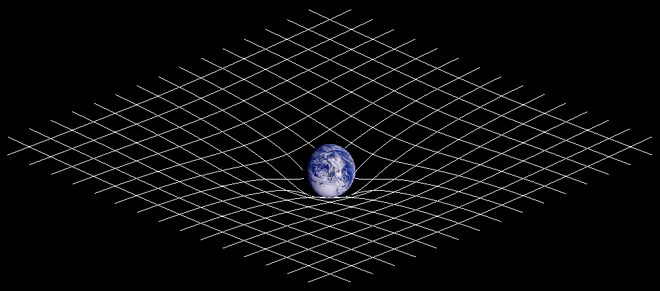
C/o Wikipedia http://en.wikipedia.org/wiki/General_theory_of_relativity
It took a couple of centuries for a convincing explanation to come along. Einstein’s General Theory of Relativity contained a lengthy list of new ideas but perhaps the most revolutionary was that space, the three-dimensional framework within which we operate, is indistinguishable from a fourth dimension, time. Einstein and his followers talk a lot about “space-time”, a combination of the three dimensions of space that we know and another dimension that reflects time. The less well-known thing is this was how Einstein was able to explain what gravity actually was. He suggested that space-time is curved. The reason that satellites move in a curve around the earth is because the mass of the Earth has warped the space-time through which the satellite moves. Imagine water circulating around a bath plughole and you get an idea of what it would look like if we could see in 4 dimensions. The satellite is actually taking the easiest route. This also explains how gravitational attraction appears to happen faster than the speed of light. Gravity is no longer an action that happens over a distance, it’s an object just following the simplest path.

Here’s the key point. Einstein’s “Theory” of General Relativity is a theory. It’s a way of explaining thing, including gravity. There is no “theory of gravity” because there’s no need. Gravity is like radiation, reproduction and rain, we don’t need proof that these things exist, the evidence is overwhelming. Theories are ways of explaining WHY and HOW known things happen, not that they DO happen.

The controversy isn’t with gravity, it’s with the other great known fact. Evolution.

Evolution happens, it’s as simple as that. It’s been observed in a wide variety of creatures, their characteristics adapting gradually as a result of changes in their environment. That isn’t denied by anyone who’s seen the evidence. Fossils show that creatures in the past were different to similar creatures today and the further back you go in the fossil record, the bigger the differences are.

There is no “theory of evolution” just like there’s no “theory of gravity”. There ARE however theories of HOW and WHY evolution happens and what makes species gradually change. So far, just as Einstein’s Theory of General Relativity explains gravity well, the best explanation we have for evolution is Darwin’s Theory of Natural Selection. Despite what you might think, and unlike Einstein’s theory, Darwin’s suggestion is remarkably simple to understand. It has only two basic ideas. When species reproduce they combine their genes randomly and this occasionally leads to offspring with particular strengths or weaknesses. The second element is just as simple to understand. Those random variations that give the offspring a better chance of reproducing and passing on his or her genes to the next generation are most likely to stick around. That’s all there is to it. Over time and thousands of generations these slight changes bring about a much bigger overall change to the species as a whole.

So far, just like Einstein’s theory, Darwin’s has shown considerable strength. Both make predictions that can be tested and so far no test of either theory has failed. Of course it might fail tomorrow and then we’ll need to come up with a new, better theory but so far there’s no need.

For now, despite what certain belief-based groups will tell you, we can stick with both General Relativity and Natural Selection as the best theories we have to explain the FACTS of gravity and evolution.

Sunday, July 29, 2012

Weekend Post - Mythtakes

Tall and short, fast and slow, left and right, science and mythology, they’re all examples from the primary school classroom of opposites. Science is the exact opposite of mythology. Science is backed up by research, evidence and facts and mythology is backed up by, errrr, nothing apart from tradition. And often that tradition is meaningless and made-up anyway.

The problem is that myths are all around us, we’re surrounded by them. I’m not talking about innocent fairy-tales like Father Christmas and the Tooth Fairy but those so-called truths that are in fact lies and distortions and that many of us fall for. Personally I blame the Internet but some of them have been around for ages. Here goes.

Alternative” medicine. It’s nonsense. The distinction between “conventional” and “alternative” or “complimentary” medicine is a myth created in order to sell things. The only real distinction is between medicine that works, and fake medicine that doesn’t. As has been said before, we tested all the alternative medicines and the ones that worked became medicine. The rest is just a bunch of herbs, some of which smell nice.

Cell memory”. Despite what alternative therapists say, it simply doesn’t exist. Cells cannot remember things. Sorry to all those followers of The Journey, but cell memory is a myth. Find me a single piece of truly scientific evidence for it and I may re-consider. The trouble is there isn’t any. None.

“Darwin denied evolution on his deathbed”. No he didn’t. That was made up by a certain Lady Hope, a lying fundamentalist Christian who claimed she had been there at Darwin’s side as he passed away. No she wasn’t. She made it all up. She never met Darwin. Not even once so she couldn’t have witnessed a deathbed conversion that never happened.

Hypnosis is an altered state of consciousness”. Well, I suppose that’s true, but only in the same sense that sneezing is an altered state of consciousness. Yes, hypnosis affects your brain but so does coffee. Hypnosis is just a mixture of extreme relaxation and some people being incredibly suggestible. There’s no magic involved, nothing deep and meaningful. Almost everything you’ve read or seen about hypnosis is utter nonsense.

Crystals have healing powers”. No, they don’t, they’re just pretty. There’s nothing special about crystals. They’re no more amazing than the glass in your window. Hang on, lenses are crystals aren’t they? If crystals could heal your ailments why can’t your spectacles?

“They’ve founds traces of Noah’s Ark”. A huge number of largely American Christian fundamentalists believe the Bible legend that Noah created an Ark and that it’s remains have been found on Mount Ararat in Turkey. No, this simply isn’t true. Much of this can be traced to a film-maker who said the Ark had been found, but the funniest thing is that this was a deliberate hoax to test the gullibility of certain religious groups. It was such a good hoax people still believe it!

“The Greeks and Romans stole their philosophy from Africans”. Yet another myth without any evidence. Much of this so-called “Afrocentrism” comes from Masonic texts. The Masons have a long history of making extravagant claims about their origins, much of it based on earlier books that, in turn, made up Egyptian history. These earlier texts were written well before we could read Egyptian hieroglyphics so Hey Presto, we have yet another myth. It’s a mythological chain made up of mythological links. Myths, all of them.

“Mary Magdelene was the secret lover of Christ”. How on Earth are we meant to believe this? It wasn’t “The Da Vinci Code” that started it, this story has been going on for ages. However as not one of the so-called historical documents is even slightly reliable how can we tell?

“Intelligence is related to race”. Well, as nobody can agree what either intelligence or race really are it’s all nonsense. It’s about as sensible as saying that “success in life” and “being a nice person” are related. We’re not going to agree on definitions of those either so it’s all a bit, well, mythic don’t you think?

“The author is a cynic who believes in nothing”. No, I believe in lots of things. Like truth that is based on facts, not just believed in because someone says we should. I believe in wonders like the safety glass that saved my eyesight when I had a car windscreen explode in my face a few years ago. An eye full of glass fragments and not even a drop of blood. That’s the sort of thing I believe in.

Some myths are fun. Those of us with kids have no doubt repeated many of them. I know I have. I’ve gone to great lengths to construct reindeer footprints outside my house on Christmas Eve, I’ve slipped Tooth Fairy money under the pillows of my children when they lost teeth and I’ve threatened them with eternal damnation if they disobey me. But none of these things are actually true. None of them are scientific, they’re all mythical and deserve either to be ignored or rejected by grown-ups. With the exception of entertaining immature children shouldn’t we abandon them?

Saturday, July 21, 2012

Weekend Post - Transplants

It’s hard to write this. A year and a half ago my Dad died. This was a tremendous shock because he was still fairly young, was fit and healthy and seemed full of life. It was a devastating experience for the entire family but despite the shock, the grief and the sense of emptiness we all felt, my mother in particular, there were nevertheless certain comforts about the way he died. The first was that the cause of death was a sudden and catastrophic burst aneurysm in his brain that caused almost instantaneous death. According to the doctors he would have known virtually nothing about it and the knowledge that he didn’t suffer remains a huge comfort to us all.

However there was an even greater comfort, something that happened after he died. Because he died in the UK the family was automatically asked if we would consent to his organs be transplanted to people in need. None of us had any hesitation in saying yes. It helped that he’d discussed it with us several times in the past and on every occasion he’d made it plain that after he was gone he’d be delighted if any part of his body could be used to help others. As a result of Pete’s death two grandmothers who never knew him now have working kidneys and are off dialysis treatment for the first time in years. Burn victims who didn’t know he existed were given skin grafts as temporary dressings while their own skin could be grown. Two blind people who’d never heard of him can now see. Trying to describe these events is the closest I ever come to using the word “miracle”.

Organ transplantation has become one of the great achievements in science over the last half a century. Despite some legends about transplants done in ancient history, genuine transplantation began in the early 20th century and as often happens it was prompted by warfare. Skin transplants began shortly after the First World War as a result of the burns so many soldiers experienced but these weren’t “donor” transplants. Skin was moved from an intact part of the patient to another, damaged part of his own body. The first successful donor transplant was in 1954 when a kidney was transplanted from one person to their identical twin, neatly avoiding the issue of “rejection”. This was the biggest challenge that transplant surgery faced. An organ taken from a donor would be rejected by the recipient’s body. It wasn’t until the 1980s that we had drugs that effectively suppressed the immune system’s desire to reject foreign tissue.

Despite what you’ll hear from some people the real breakthrough wasn’t in South Africa, where Christiaan Barnard successfully transplanted a heart in 1967. In the next few years over a hundred more transplants were undertaken in South Africa but very few of the recipients lived more than a couple of months. Barnard and his colleagues cracked the plumbing side of things but the real breakthrough was the immune suppressors that became available in the 1980s. [Yes, I know describing transplant surgery as “plumbing” is insulting but I’m sure you get the idea.]

As a result of these immune response suppressors in countries like the UK transplants can now almost be described as routine but this is just one technique to fix broken bodies. Carnegie Mellon University in the USA recently announced the award of a $1.1 million grant to a researcher to develop an artificial retinal implant to help people with impaired vision to see better. A wafer thin film will be inserted behind the retina with electrodes to stimulate nerve signals from the eye to the brain using signals coming from a special pair of glasses the patient will wear. In effect the glasses will act as a camera feeding information into the brain through the retina.

The long-term future is even more impressive. Regenerative medicine offers the possibility of growing replacement parts of the body to replace damaged or diseased ones. Using stem cells either from umbilical cord blood or bone marrow, bits of body might be grown to provide spare parts. So far this has been done with fairly simple body parts like cartilage, trachea and even the tip of a finger but it’s early days yet. Once we become more familiar with how to manipulate stem cells the possibilities are amazing.

However all of this faces the usual threats from ignorance and religion. Shortly after Pete died I mentioned his death and organ donation to a shopkeeper who knew him. He expressed the usual sympathy for our loss but pointed out that “in my religion we don’t permit transplants”. I restrained myself from pointing out that I felt that whatever religion he followed was clearly an immoral one.

There’s been the same objection in principle to the stem cell research that would enable regenerative medicine, mainly because of the mistaken perception by certain faith groups that stem cells are obtained from aborted embryos. While this is possible, and was once thought of as a source of stem cells, things have long since moved on to much simpler sources. But that hasn’t prevented the religious right-wing in the USA and elsewhere from resisting progress yet again.

Stem cells offer humanity an unparalleled opportunity to cure disease and restore damaged bodies. The forces of ignorance cannot be allowed to prevail. My Dad would have wanted progress.

Saturday, July 14, 2012

Weekend Post - The Higgs

It had to be the Higgs boson, what else could I write about?

The recent discovery of persuasive evidence of the existence of this mysterious sub-atomic particle is one of the biggest discoveries in physics in recent decades. It really is a big one. Strangely it doesn’t actually introduce anything new to our knowledge of the universe but it does confirm our current understanding of how things work. For now.

This current understanding is usually called “The Standard Model”. This describes the different types of sub-atomic particles that comprise everything that we can see and sense. It describes particles such as electrons, the quarks that make up protons and neutrons, photons and a range of bizarre things that collectively comprise matter and it’s non-identical twin, anti-matter.

One mystery that the Standard Model couldn’t fully explain was mass, the amount of physical “stuff” that each particle comprised. Some had lots of it, some just a little, others none at all.

In 1964 Peter Higgs, a physicist at Edinburgh University, predicted the existence of an energy field throughout the universe that would explain why things had mass.

Higgs suggested that certain particles have mass only because they interact with this field, now called the Higgs Field, as they pass through it. The more particles interact with the field, the more they develop mass. Those that interact travel slowly as a result, those that don’t continue travelling at full speed, the speed of light. Photons, the particles that make up light, whizz around at blinding speeds, the particles that make up you and me lumber around like elephants in custard.

But all of this has been theoretical until recently. Two competing laboratories, Fermilab in the USA and CERN who host the Large Hadron Collider in Europe have been doing their best to discover evidence of Higgs’ prediction using a technique that doesn’t sound that advanced. Each has constructed massive particle accelerators that shoot atomic particles at each other at speeds very close to the speed of light and see what happens. You could argue it’s a bit like trying to work out how a cellphone works by repeatedly hitting it with a hammer but it is actually more thoughtful than that.

CERN, having a bigger and more powerful accelerator were the ones most likely to make any discovery and that’s what appears to have happened. Last week they announced that they had found convincing evidence amongst all those particles smashing around of something that really looked like a Higgs boson, one of the particles that makes up the Higgs field. Like all decent scientists they’re treading cautiously, they’re not actually saying they caught the real thing yet, they’re just saying that they saw something that was “consistent with” a Higgs boson. Like proper scientists they had done the maths properly. The chances of what they saw not being a genuine particle was at the “5-sigma” level of certainty, 5 standard deviations away from the mean, in other words there’s only a 1 in 3.5 million chance that this isn’t genuine. As the Director General of CERN said: "As a layman I would now say I think we have it."

There is one major misunderstanding that many people have experienced about the Higgs boson. For some unaccountable reason, much of the media decided to refer to it as the “God particle”, a reference to a popular science book published twenty years ago. The particle of course has nothing to do with God, religion or anything “spiritual”. Higgs himself has rejected the term, not because he is religious, in fact he’s an atheist, but because he doesn’t want his theory to offend people who have religious sensibilities.

So where do things stand, now that we’re confident the Higgs field exists?

The Standard Model is still with us, but there’s still a lot of things we don’t know. Perhaps the most mysterious is the existence of “dark matter”, the matter that our understanding of physics says is out there but we just can’t see. About 95% of the universe is invisible.

Unfortunately, covered up by the almost hysterical reaction to the Higgs’ discovery was another, much quieter science news story, one that’s perhaps just as important. A paper published in Nature announced the first observations of wispy filaments of dark matter between galaxies connecting the much larger clumps of dark matter whose enormous mass give the universe it’s gravitational structure. While the word “filament” might imply that these things are small and insignificant in fact they’re massive. The filament identified is estimated to be a billion trillion kilometers long and has a mass a hundred trillion times greater than our sun. So not exactly small.

The wonderful thing is that in the same week scientists have discovered something unimaginably small and something else unimaginably massive, both of which were predicted but not yet spotted. Both perfect examples of the scientific method. Create a theory that explains things, make predictions from it, identify how it can be tested and then sit back and wait.

Sunday, July 08, 2012

Weekend Post - Wishful thinking

You can’t make things happen just by wishing for them. No, you really can’t.

Despite what New Age mystical thinkers like the authors of The Secret will tell you, positive thinking is utterly useless. If you make the mistake of buying a copy of The Secret, you’ll learn that their nonsensical “Law of Attraction” suggests that positive thinking will magically lead to positive results. In the same way, thinking sad thoughts will lead to sad things happening, anger will beget anger and homicidal thoughts will transform you into a combi driver.

For a moment let’s ignore the fact that this is nonsense. Does this really mean that Jews got themselves Holocausted because they weren’t thinking positively enough? Did slaves get kidnapped and murdered because they weren’t looking on the bright side of life? Do murder victims deserve it? That’s what The Secret implies.

It IS nonsense of course, there’s absolutely no evidence whatsoever that wishful thinking works. In fact there’s evidence that it doesn’t. It’s not exactly the same thing, but there HAS actually been some experimentation into one form of magical thinking: prayer.

Does praying for sick people actually help them? Millions of people are told by their religious leaders every week to pray for the sick and unfortunate so it must work, mustn’t it?

No. It doesn’t. While there have been experiments showing some benefit, so far all of them have been discredited. One of them was even undertaken by a mixture of researchers who didn’t actually exist, others whose names had been hijacked and another who was a convicted criminal.

One of the very few properly controlled, truly scientific experiments was undertaken by a Harvard professor in 2006. A sample of 1,800 heart patients was divided into three groups. Group 1 were prayed for by unnamed strangers but didn’t know this was happening. Group 2 were not prayed for and also didn’t know this. The members of Group 3 were prayed for but they were told this was happening. The real test would be whether there was a difference in outcome between Groups 1 and 2. Did the prayers offer any benefit to people who didn’t know it was happening? The results (pdf file) were disappointing for the believers. Precisely no difference. The prayer had no observable effect on people who didn’t know they were the “recipients” of it.

However the really interesting thing though was what happened to the third group, the patients who knew strangers were praying for them. Members of this group had a noticeably greater level of complications. It seems that knowing that people are praying for them actually seems to have made them more unwell. Whoops.

The non-religious equivalent of prayer, often used in business, therapy and sports, is visualization. People are taught to picture mentally their success, their happiness and prosperity and are taught that this will help these things come true.

The science is simple. Visualization works but only if you do it the right way. Despite what the mystics will say, imagining success doesn’t work. What DOES work is imagining HOW you might succeed. Successful athletes don’t visualize winning the race, they visualize how they will win it. They picture leaving the starting line, how they accelerate, how they control their breathing, how they maintain their speed and how they cope with the pain. Students who visualize HOW they’ll study for that exam do better than the ones who just imagine getting an A grade.

I’m not really a big believer in self-help books but if you are interested in making changes to your life and you want to use techniques that actually work, go and buy a book called 59 Seconds by Richard Wiseman. Wiseman is a psychologist who has done genuine research into the vast array of self-help myths and talks about the things that actually work and dismisses the pseudoscience that doesn’t. He discusses exactly how techniques like visualization can actually help but also covers how to do better in interviews, reduce stress and even how to do better on a first date and it’s all based on scientific research. And the reason the book is called 59 Seconds? It’s because every suggestion he gives can be understood in less than a minute.

Wiseman also recently wrote an article in the UK’s Guardian newspaper in which he discussed the fallacy of positive thinking. In particular he mentioned the studies showing that students who visualized success in their examinations actually ended up studying less and performing more poorly in the exams. Another study showed that graduates who fantasized about getting fantastic jobs actually received fewer job offers and got lower average salaries.

The irony is that positive thinking and visualization are perhaps the worst things you can do to achieve success. Maybe instead you should try the scientific approach. Get off your backside and take some action instead of just fantasizing. The science will support you.

Sunday, July 01, 2012

Weekend Post - Vaccinating against intelligence

Intelligence is dangerous. What’s more dangerous is skepticism. Worst of all is the combination of both.

It’s not that knowing more about the world and questioning received wisdom will directly threaten you but it they will both expose you to things that you might not want to experience. Things like uncertainty, doubt and the acceptance of ignorance. The nature of science, the primary tool used by skeptical, intelligent people to conquer ignorance, is that it’s incomplete. There are things we don’t know, at least not yet. One day we will. We’ll know whether dark matter and dark energy exist, we’ll know whether string theory does indeed reconcile relativity and quantum theory, we’ll even know why combi drivers drive the way they do. One day.

But some things we DO know. There are things we know for sure, about which there is absolutely no doubt. Gravity exists and we now have a very good theory that explains it. Evolution happened, is still happening and will continue to happen and we have theories that explain it very well. More practically we know for sure that vaccinations work, they protect us against dreaded diseases and they’ve extended our lifespans enormously. That’s why it’s horrible to hear of cases of resistance to vaccination. Earlier this month the Pakistani Express Tribune reported on objections to an anti-polio vaccination campaign in the Punjab region of Pakistan:
“When the local cleric, Maulvi Ibrahim Chisti found out about the campaign, he immediately went to the biggest mosque in the area and declared that polio drops are ‘poison’ and against Islam. He added that if the polio team forced anybody to partake in the vaccination campaign, then Jihad was ‘the only option’.”
Clearly this particular religious leader is an idiot. As a result of idiocy like this, the Indian Express reported that polio is back.
“Eight cases were detected in the Khyber tribal region. Polio cases have also been reported in areas like Rajanpur district of Punjab and Larkana district of Sindh that were free of the virus since 2004-05.”
It’s not often that progress is actually overturned and the forces of idiocy drive us back into the Middle Ages. With a little luck the pragmatic Pakistani authorities will enforce some reason and rationality and Pakistani kids can live life with one fewer threat to their health.

However it’s not just the ignorant that oppose vaccination.

In the UK in 1998 a doctor called Andrew Wakefield published a fraudulent study in The Lancet incorrectly suggesting that there was a link between the Measles, Mumps and Rubella (MMR) vaccine and autism. He even invented a fictitious medical condition that he called “autistic enterocolitis”.

This caused a major panic in the UK that spread worldwide. Unfortunately it took many years to fully expose Wakefield as a fraud. In 2004 the UK Sunday Times journalist Brian Deer revealed Wakefield’s fixing of experimental results, his improper and unethical treatment of children and his corrupt financial interests. Faced with this The Lancet fully retracted the article and the UK’s General Medical Council formally investigated Wakefield’s conduct. They were so horrified by his conduct that he was struck off the medical register in disgrace. There were even calls for him to be prosecuted.

But the damage was done. MMR vaccination rates dropped significantly. In the UK the vaccination rate dropped from 90% to 73%. In the USA more cases of measles occurred in 1998, following the reports, than had occurred in the decade beforehand. Obviously nobody can prove this beyond doubt but it’s likely that Wakefield’s activities killed children.

The fascinating but dreadful news is that despite Wakefield and his ideas being completely discredited, despite every single piece of evidence showing that childhood vaccination is a life-saver, vaccination levels in the developed world haven’t recovered. Worse still we can’t make the easy assumption that the parents of the non-vaccinated children are all stupid. In fact according to a study published in the New England Journal of Medicine, unvaccinated children in the USA were more likely:
“to belong to households with higher income, to have a married mother with a college education, and to live with four or more children”.
The irony is that the more educated you are, the less likely you are to protect your children’s health. Part of this is undoubtedly the higher levels of curiosity that intelligent and educated parents are likely to express. In particular smart people (like readers of the Weekend Post!) are more likely to surf the web to research important decisions. The problem is that the Internet is filled to the brim with a mixture of lunacy, idiocy and lies. That’s if you can avoid the porn and celebrity gossip. The pseudoscience available on the Internet is dangerously prevalent.

Many examples of progress are mixed. While nuclear power is the safest way to produce electricity we all find radiation scary. The internal combustion and jet engines have each made travel easier but they bring pollution. The internet can be wonderfully empowering but it’s full of garbage.

Vaccination is an exception. It’s saved and prolonged everyone’s life and there is virtually no downside to it. The terrible irony is that the greatest threat this remarkable bit of scientific progress faces is the very same intelligence that created it.

Saturday, June 23, 2012

Weekend Post - the organic food deception

Why do people seem to think that things that are “natural” are somehow better than things seen as “unnatural”? Why is “organic” food so highly prized? Why do people object to “unnatural” additives in their foods, medicines and even their clothing?

Anyway, what does “natural” even mean?

Of course many natural products are perfectly wonderful. Oxygen is natural. Water is natural. Vitamin A, otherwise known as retinol, is natural. But all of these things, if taken to excess, will kill you. Arsenic, cyanides and many bacteria are all perfectly natural but they too will kill you stone dead. Lions and hippos are natural, as are mosquitos.

Unnatural products like anti-retroviral drugs, plastics and semiconductors have improved the quality of our lives almost immeasurably. Hospital operating theatres, telephone exchanges and refrigerators are all completely unnatural.

It’s not as simple as natural is good, unnatural is bad. That’s the “naturalistic fallacy”.

A very good example of the exaggeration of the benefits of so-called natural products is the organic food industry. Again we have to play with words a bit. All foods are organic, they’ve all come from some other form of life, whether animal or vegetable. Organic foods are no more “organic” than conventionally produced foods. So-called organic food is actually just conventional food that’s been grown, processed and delivered according to certain agreed standards. It’s similar to the production of Haalal meat. Fundamentally there’s no noticeable difference between an organic potato and a conventional one, just like there’s no observable difference between a Halaal chick burger and a conventional one. It’s just the production method that’s different.

Organic foods are produced largely without modern farming products like pesticides, veterinary products like antibiotics and modern fertilizers. That’s the main reason why organic foods are so expensive. In a store I visited recently they offered conventional spaghetti and organic spaghetti for exactly three times the price. Given that there’s no noticeable difference in taste, texture or quality I happily bought the cheaper version.

Perhaps the biggest argument for organic food, and the reason that many people are willing to spend three times as much for certain items is that they think it’s somehow healthier. The inconvenient truth for the followers of the organic movement is that there appears to be no evidence for this whatsoever. None.

In fact some of the fertilizers used in organic farming are really rather scary. Although the chemicals often used are “natural” that doesn’t mean they don’t cause cancer, Parkinson’s disease or food-poisoning. Unfortunately the organic food movement has resurrected an old farming practice that industry had begun to eradicate: spreading excrement over growing crops.

Here’s a simple science lesson. Excrement, faeces, poo, whatever you want to call it, is bad for you. Why do you think we spend so much time disposing of it hygienically? Why do you think we’ve evolved over millennia to find it revolting? It’s because given the slightest chance it will kill us, that’s why.

One of the tragedies in science is how little certain scientists are known. Most educated people can think of Einstein, Newton, Curie and Pasteur. Others can perhaps name Fleming, Lister and Watson and Crick. But how many know of true greats, absolute heroes like Norman Borlaug? As well as winning a huge variety of international awards, Borlaug was awarded the Nobel Peace Prize in 1970 for his contributions to the world food supply. It’s impossible to prove but it’s been said that Borlaug and his work in agriculture saved perhaps a billion human lives by drastically increasing crop production.

Like many great breakthroughs Borlaug’s achievements sound very simple. He made maximum use of seasons, used multiple genetic lines of crops to provide disease resistance, planted stronger, dwarf strains of crops that were much sturdier and, just as importantly, made liberal use of inorganic fertilizers. He encountered enormous resistance from well-meaning but ignorant objectors to this approach and some of the most aggressive objections came from the so-called “environmental lobby”, probably the very same people who can afford to pay silly prices for organic foods. Borlaug’s reaction was damning:
"Some of the environmental lobbyists of the Western nations are the salt of the earth, but many of them are elitists. They've never experienced the physical sensation of hunger. They do their lobbying from comfortable office suites in Washington or Brussels. If they lived just one month amid the misery of the developing world, as I have for fifty years, they'd be crying out for tractors and fertilizer and irrigation canals and be outraged that fashionable elitists back home were trying to deny them these things."
Organic food advocates should think hard about this. If they want to spend three times as much on food that’s absolutely identical to normal food, offers no real health benefits and doesn’t help the environment even a tiny bit then they’re welcome to. Just leave the rest of us out of it please?

Saturday, June 16, 2012

Weekend Post - the problem with chiropractic

Most so-called “alternative” health treatments are fundamentally harmless. Reflexologists, acupuncturists and the purveyors of nonsense like Reiki, energy medicine and QXCI are highly unlikely to harm you, let alone kill you. That’s because none of these “therapies” actually DO anything. Of course there IS the risk that someone will use these fake treatments instead of real medicine and suffer as a result. A friend of mine is a doctor who I once saw deeply upset because a patient who’s life he had improved dramatically, whose life he’d probably saved, ended up dead because he’d dabbled with nonsensical “traditional” medicine.

There are, however, alternatives that CAN do harm, that CAN hurt you. Chiropractic is a good example of this.

Chiropractic is, like most “alternative” therapies, based on a ridiculously simplistic view of the human body. Energy medicine practitioners will tell you that it’s all about balancing energies, reflexologists invent pathways between the soles of your feet and the rest of your body and the QXCI “therapists” don’t have any idea what they’re doing. Chiropractors will tell you that many disorders are due to “misalignments” in your spine that are somehow interfering with nerve signals from your brain. They claim that manipulating the spine can free these nerve signals and improve the victim’s health.

Let’s start with the facts. This is all utter nonsense. Even chiropractors admit this. The UK General Chiropractic Council admits on its web site that the basic idea behind their profession:
“is not supported by any clinical research evidence that would allow claims to be made that it is the cause of disease or health concerns”
If even the governing bodies admit that it’s nonsense, why do individual chiropractors think we should trust them?

Admittedly, a number of chiropractors have moved away from these ridiculous claims and now include more mainstream ideas in their thinking and treatments. However there is little evidence that anything the more modern ones do has any genuine effect either. The overwhelming body of evidence suggests that spinal manipulation for back and neck pain offers no greater benefits than massage or taking some painkillers.

Then there are the dangers. People have died as a result of chiropractic treatment. Just last week the BBC reported on a warning published in the British Medical Journal about the low-level risk posed by spinal manipulation. Describing the procedure as “unnecessary and inadvisable” they highlighted the risk of damage to the arteries in the neck that might result in a stroke. This risk isn’t just theoretical. There are many documented cases of people being permanently disabled and even being killed by their chiropractic treatment, by the chiropractors themselves.

Of course alternative therapists will say that this happens in conventional medicine as well and they have a point. People do sometimes suffer side effects of modern medicine but its very rarely the treatment itself that directly harms them. Having a chiropractor, who would be forced to admit that his therapy was not based on any science, fool around with your spinal cord is asking for trouble.

Some years ago the chiropractic industry in the UK suffered an enormous setback when the British Chiropractic Association tried to sue the science writer Simon Singh for defamation. He had criticized chiropractors’ claims that they could successfully treat children with asthma, ear infections, colic and sleeping problems. He said that the BCA “happily promotes bogus treatments” and they sued him.

The good news is after a lengthy court battle the BCA was forced to drop their case against him because they realized they were going to lose. What he’d said was true. Unfortunately, unlike here in Botswana, the British legal system has no “public interest defense” to allegations of defamation.

One effect of this case was a massive increase in the number of complaints against chiropractors for false advertising. One report suggested that 25% of all practitioners in the UK were under investigation for making false claims. The “profession” remains in crisis to this day, having brought public attention to itself by trying to bully a science writer for telling the truth about their treatments.

The irony is that it took a court case, not scientific evidence, to force chiropractors to face up to the truth about their bogus, pseudoscientific claims. Hopefully science can prevail in future without the support of the courts?

Saturday, June 02, 2012

Weekend Post - Stemming stem cell research?

One of the most controversial areas of scientific research in modern times is stem cell therapy. Actually, it’s only controversial because certain religiously motivated groups have decided it should be controversial, regardless of the scientific truth. In fact there’s no controversy at all if you look at the facts.

Some background would be useful. Everyone reading this was originally formed from a single human cell, an egg from your mother. Once fertilized by your father’s sperm that single cell divided into two, then four, eight and so on until your body consisted of tens of trillions of cells. Here’s the clever bit. That single original cell gave rise to an enormous range of different, specialized cells. Your body contains around 200 different types of cells that are each devoted to specific purposes. Some transmit messages in your brain, others help your heart pump blood, others exist in your liver solely to “detox” your system, others receive light in your eye. The variation is amazing but they all came from that single generic cell. They all “stem” from that single cell.

These stem cells have that amazing capability: to become other types of cells. Like that first cell from your mother that created you, they have the capacity to produce the specialist cells needed in specialized organs. One of the biggest hopes in modern medicine is to find a way of introducing stem cells into damaged or diseased tissue to grow new tissue to replace the damaged bits.

This would be revolutionary and might offer us an enormously powerful technique to help cure a range of conditions.

The controversy came from one of the original sources of stem cells for research: human embryos, either from aborted embryos or from spare embryos created during fertility treatments. I can understand how people would find this instinctivel a little distasteful but these embryos weren’t in any real sense human. They had developed no further than the blastocyst stage when the embryos consists of no more than about 100 cells. In real terms they were no more “human” than the fleshy inside bit of your tooth.

However, whether rightly or wrongly, there was considerable resistance to using embryonic stem cells in research. Former President George W Bush even banned their use in any federally funded research programs.

The good news is that it looks like we can avoid the need for embryonic stem cells entirely. Stem cells can be harvested instead from adults, avoiding any of the emotional complications arising from embryo use. In fact we’ve been using adult stem cells to treat disease for years, it was just never called that. Bone marrow transplants, most commonly used to treat leukemia, actually use the stems cells found in adult bone marrow.

Bizarrely one of the richest sources of adult stem cells is the dental pulp tissue found inside adult teeth. These stem cells could, in principle, be used to grow new heart and nerve tissue, muscle and bone. The potential is extraordinary.

It’s early days but there’s great reason to be optimistic. A recent study published in The Lancet used stem cells taken from the heart tissue of heart attack victims. The scientists cultured stem cells from this tissue and re-implanted them into the damaged heart. Four months after the procedure, those participants who had received the stem cells had a significant improvement in heart function compared to a group who had not been given stem cells. The improvement wasn’t complete, their hearts were still damaged, but every little improvement helps tremendously in heart attack patients and it shows the potential for the procedure.

A similar study in Israel, which involved introducing stem cells into the hearts of rats, confirmed that the stem cells were busy bonding with existing heart tissue. The lead researcher, Lior Gepstein from Rambam Medical Center commented to the BBC that “we have shown that it's possible to take skin cells from an elderly patient with advanced heart failure and end up with his own beating cells in a laboratory dish that are healthy and young - the equivalent to the stage of his heart cells when just born."

The potential for stem cell therapies is enormous, so long as ignorance isn’t allowed to get in the way.

Saturday, May 26, 2012

Weekend Post - Are you in control?

Here’s a test for you. With the index finger of the hand you write with, touch either your left ear or your right ear. It’s entirely up to you to decide which ear to touch.

Done that?

How did you decide which ear to touch? Did you think about it logically? Did you give it a lot of thought or just choose the nearest one?

The question is really about free will. Did you actually have a choice at all or was it predestined that you would choose that ear?

Theologians, philosophers and everyday people have wondered about this issue for centuries. Do we actually have control over our actions or is everything predestined? Can I really decide what I’m going to do or is it all written down somewhere? Frankly I’m not terribly interested in the metaphysical side of things. I want to know, and I think this matters a whole lot more than a bunch of mystical ponderings, what does the evidence say?

Luckily we have now have the technology to investigate the brain. We can measure activity in the brain with some accuracy, we can estimate fairly well when things happen. That’s proved to be fantastically useful to anyone studying the brain and it’s functions.

In the 1980s a neuropsychologist called Benjamin Libet and his team in California did an experiment that had disturbing results. They looked at the time it took for their subjects to take a decision to flex a muscle and then for the muscle to flex. In fact there were three separate events that they measured. Firstly the conscious decision itself, then the activity in the brain that sent the signals to the muscle and finally the muscle flexing. Mind, brain then muscle. That’s surely how it works? A conscious decision leads to brain activity and then the muscular action happens. It can’t be much simpler than that, can it?

Actually it IS more complicated than that and even a bit disturbing. It turns out that the conscious decision occurred, on average, about 200 milliseconds before the muscle flexed. So far so good. The surprising thing is that the brain activity that sent the signal to the muscle started even earlier, on average 500 milliseconds before the muscle flexed. Let me make that perfectly clear. The brain began preparing the signal to the muscle BEFORE the subject had consciously decided to do anything. The correct sequence appeared to be brain, mind and then muscle. Free will would seem to be an illusion if Libet’s findings are correct.

Libet’s work has been heavily criticized but mainly because of it’s implications, not the science. The experiment has been repeated and adjusted to explore the effect more closely and although the findings have been modified slightly, the essence remains the same. The brain is busy BEFORE the mind does anything.

So what role does the mind have in this situation? One role it might play is simply as a mechanism for giving us a “sense” of control, of what philosophers called “agency”, the sense that we exercise some control over ourselves. Another intriguing idea is that although “free will” might be an illusion, we still might have what researchers have jokingly called “free won’t”, a final veto on the actions we take. The role of the mind might be just to stop things happening rather than causing them to. So, male readers, this research does NOT give you that great excuse, “I’m sorry dear, I couldn’t help myself, it was an irresistible urge”.

However, even that idea is under attack. Other experiments have suggested that free will truly is no more than an illusion, an experience created by our brains to give us that sense of agency that we like, that allows us to explain our behavior to ourselves.

Those of a religious persuasion, and even those who are not, find this disturbing. People will say that this means we have no conscience, no sense of morality or ethics, no knowledge of right and wrong. That’s just rubbish, this is NOT what this research suggests. Nobody has suggested that we don’t learn things, that we don’t instinctively have a sense of right and wrong and that our parents and society can’t give us morality.

Of course that all happens. It’s just that the evidence suggests that we don’t consciously think about these things when we make specific decisions. But they’re still there, influencing our decisions, our personalities and our lives. There is no contradiction between having no free will and being a decent, caring person who makes the right decisions, who recognizes morality and who lives a decent life.

In fact I’d go one stage further. I think this places an emphasis on us, as individuals, to think more about right and wrong, to care even more about the morality we teach our children and how we live our lives. It’s just that we can now do this based on real knowledge, science and evidence, not superstition.

Saturday, May 19, 2012

Weekend Post - Bad ideas stick around. Like astrology.

I find it amazing how certain ideas stick around, way beyond the end of their natural lifetimes. There are still people who believe in witches, evil spirits and mysterious forces controlling our destiny. There are still people who believe, fundamentally, in fairy tales. However, perhaps the longest running nonsensical and straightforwardly WRONG belief is in astrology.

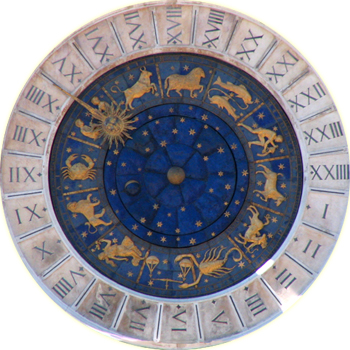
Source: http://en.wikipedia.org/wiki/Astrology
Astrology is based on the belief that the planets have some sort of effect upon our daily lives. It suggests that the date and time of your birth and the position of the planets at that moment have an everlasting influence on your life and the events it includes.

Most astrologers also suggest that we can all be grouped according to the month of our birth into so-called star signs. These signs are named after a range of astronomical constellations like Cancer, Libra, Taurus and Sagittarius. Apparently people in each of these groups share similar personal characteristics and, if you believe the astrological predictions published in newspapers over the world, identical life experiences each week.

Where to begin on this one?

To begin with let's think carefully about each of the issues. Firstly that the planets have a direct influence on our lives. How do they do this? The only force we know of that might do this is gravity. Gravity can act at a huge distance, it holds the planets in orbit around the sun and the sun in it's place in the galaxy. There’s no point in going into the physics of this other than to point out that there’s a greater gravitational attraction between you and your husband or wife than you have with Jupiter. The moon has a much greater gravitational influence on our planet than all the planets combined so why do astrologers ignore it's influence?

So, given that the gravitational effect of the planets on us is insignificant isn't it also stretching our credibility a bit too far to believe that the effect they have on us is at the moment of our birth and not at any time later? Oh and why don’t astrologers consider the moment we were conceived rather than the moment of our birth? Surely that would be more logical? However logic is not something that astrologers seem to rate very highly.

So perhaps there is some other force that has this effect. Some force that we don't know about yet? If astrology is actually a good predictor of life's events maybe that would be good enough proof? If astrologers could show us that their predictions were accurate that would be a good thing wouldn't it?

Unfortunately it's simply not the case. Every truly scientific analysis of astrological predictions has shown that astrological predictions are nonsense. They predict nothing. If they did why didn't astrologers tell us about 9-11, the banking crisis or who was going to win Big Brother? And why aren’t they all multi-millionaires having predicted lottery results?

Experiments that looked at couples who got married and analysed their star signs showed that there was absolutely no relationship between the so called compatibility of their signs and whether their marriages lasted or not. The same thing happened when researchers examined people in various professions and found that their astrological signs were in no way related to their professional success.

However my favourite experiment has been undertaken several times, notably by the French researcher and astrologer Michel Gauquelin. He gave a large group of people a horoscope and asked them to rate how accurately it described their personality. Ninety-four percent of the people said it accurately described them. The bad news though is that they had all been given the very same horoscope, that of Marcel Petiot, one of France’s most vicious psychopathic serial killers.

This is an example of the so-called "Forer effect", the tendency people have to consider general statements about them as correct, particularly when they're flattering. It's our nature to believe this sort of garbage when we hear it. But that doesn't mean we have to give in to idiotic temptation.

So why do so many people read their horoscopes and feel that they actually mean something? Why do they genuinely seem to believe they predict what will happen and give guidance on what they should do?

I think it's quite simple. We all want certainty. We want to be able to understand our lives and astrologers give us this. They give us simple, amazingly broad generalisations that can apply to pretty much anyone. A horoscope in a newspaper here recently stated that any Capricorn should"
"Use your time as productively as possible. Individual achievements are possible within a working team structure. A game of one-upmanship might ultimately benefit everyone."
What utter rubbish. What on earth does this mean? What sort of a prediction is that? Notice how deliberately vague that all is? Couldn't it apply to anyone at any time?

People believe astrology because they seek simple explanations for a complex life. Fortunately life is much more complex and interesting than this and astrology is utter nonsense.

Saturday, May 05, 2012

Weekend Post - Two types of thinking?

It’s been said that there are two types of people: those that divide humanity into two types and those that don’t.

Crudely dividing humanity into “types” is always a very dangerous pastime. Despite what some will say you can’t divide humanity into black and white, straight or gay or even male or female. In all cases there are people in between. One of the most ridiculous books in recent years was entitled “Men are from Mars, Women are from Venus” by “Dr” John Gray. To my shame I have a copy of this fatuous book beside me as I write this. No, I didn’t pay for it. Nor did I steal it.

I put the “Dr” in quotes for the simple reason that he doesn’t have a real doctorate. His obtained his PhD from Colombia Pacific University, a now closed diploma mill. I know I risk being accused of an “ad hominem” attack but can you trust the work of a person who buys a fake degree and who got his first two degrees from that fabulous old fraud, the Maharishi Mahesh Yogi?

Whether you can or not you can certainly reject his ridiculously simplistic, crude and wholly unscientific idea that men are basically cavemen and women are conversationalists and that the way they communicate is radically different. Some may argue that I’m also being simplistic but too bad. Simplistic ideas can only be described simplistically.

Of course I’m not going to deny that there are differences between women and men, between girls and boys, of course there are. No matter how strong our liberal convictions may be, anyone who’s had kids knows that at least part of the nature of girls and boys is biological. That doesn’t mean we shouldn’t give them all equal opportunities and expose them to the same experiences and influences, but it genuinely helps to understand the differences that affect them.

I suggest that instead of reading fake, pseudoscientific claptrap like Gray’s book you read instead a book by Steven Pinker called The Blank Slate (available in all good book shops or online). My favourite quote from the book (also beside me as I write and this one I DID pay for) discusses the differences between men and woman and goes like this:
“So men are not from Mars, nor are women from Venus. Men and women are from Africa, the cradle of our evolution, where they evolved together as a single species.”
The evidence is that the differences between the minds of men and women are trivial at most and are only based on averages. Although men tend to be slightly better at three-dimensional reasoning than women this is only on average. There are plenty of women who can easily reverse a car, just slightly more men. There are plenty of men who demonstrate empathy, just more empathetic women. The most interesting difference is that on many measures men are more varied than women and are more often found at the extremes. Male mathematical geniuses outnumber their female counterparts but there are also many more men and boys with autism than girls.

A recent study, published in Science, and conducted by the University of British Columbia in Canada looked at the two types of thinking that humans demonstrate. The first is intuitive, the other analytical. The intuitive process makes snap judgments based on “mental shortcuts”, the analytical process is the one that takes longer to consider things in a more “reasoned” manner. The Los Angeles Times gave one of the questions the study had used as an example. See how you answer it.
“A bat and a ball cost $1.10 in total. The bat costs $1.00 more than the ball. How much does the ball cost?”
Most people intuitively respond by saying the ball costs 10 cents but it’s only when they think analytically that they realize their mistake. The answer is 5 cents. Go back and think about it again if you doubt this.

We all have both of these thought processes and each of them has their role to play. When our distant ancestors were in the bush and they heard a rustling sound from behind the grass they had to act intuitively. They didn’t have the time to think analytically, it could be a lion, they had to act intuitively. Analytical thinking in those circumstances only benefits the hungry lion. Analytical thinking is good when you have the time to indulge in it.

The focus of this study was controversial to some. It looked at religious belief and found that people who think more analytically were less likely to be religious. Religious belief was much more often found in people who thought more intuitively.

What this means for religious belief I’ll leave up to you. It doesn’t mean religion is right or wrong, it just helps us to understand where beliefs based on faith come from. It’s clear that they certainly don’t come from reason.

Saturday, April 28, 2012

Things we don't understand. Yet.

One of the most powerful words in the scientific vocabulary is “yet”. As in “We don’t know the answer to that question. Yet.”

It’s one of the biggest challenges that the opponents of science face, trying to understand how scientists and the followers of the scientific approach can cope with not knowing things. It’s particularly hard for those followers of belief systems who offer fake certainty, all-encompassing but wrong explanations for life’s challenges and a bogus absence of doubt.

In fact science actually welcomes doubt and uncertainty. After all if the scientific method provided all the answers it would simply stop. There’d be nothing left to do, no more findings to find, no more fun to have.

The greatest of all the uncertainties we face at the moment is also the simplest to understand. Where the hell is everything?

c/o Wikipedia http://en.wikipedia.org/wiki/Dark_matter
Our current understanding of the universe suggests that most of the matter out there in the universe is missing. The way the galaxies are moving in relation to each other suggests that there should be a lot more “stuff” out there than we can see. Only a huge amount of missing matter could explain why the galaxies are gravitationally attracted to each other as strongly as they are. We’re pretty sure it’s out there somewhere but we just can’t see it. That’s why it’s called “dark”.

And it IS a big chunk. The mathematics suggests that something over 80% of all the matter that exists is this invisible, dark matter.

This is the biggest puzzle in physics at the moment and astronomers and theoretical physicists all over the world are doing their best to come up with a suggestion about what this stuff might be. The current consensus is that it’s not matter that’s simply hiding, it must be something entirely new, something that we simply don’t know how to detect. Yet.

For scientists this is as good as it gets. The uncertainty, this gap in humanity’s knowledge is the sexiest thing they can imagine. In order to find this dark matter they’ll need to develop new theories, new experiments and new observations that can help us solve the problem. They’re going to have to push themselves and their imaginations to the limits.

A good example of a problem that was eventually solved was the seemingly bizarre behavior of the Pioneer space probes. These were launched in the early 1970s to explore the outer planets and achieved spectacular results. After this was over a strange thing happened. As these probes disappeared into the depths of space it was noticed that they were slowing down a bit more than expected. The mission controllers knew that this would happen a bit because of the combined gravitational pull of the Sun and the planets but their calculations couldn’t explain why it was slowing down as much as it was.

A huge variety of explanations have been proposed but none seemed quite right. Scientists were puzzled and didn’t have a good explanation. Yet.

Now they have. After trawling through vast amounts of data they’ve worked out a very persuasive explanation. It’s not interplanetary material, it’s not aliens, in fact it’s nothing extraordinary at all. The solution is almost mundane but it’s still elegant. It turns out that the on-board power generators, like most power sources, radiate small amounts of heat, but the heat on the Pioneer probes wasn’t radiating equally in all directions. More thermal radiation was shining forwards, in the direction of travel, than backwards towards the Sun. It’s as if the probe was shining a torch ahead of itself. That tiny amount of “photon pressure” accounts for the tiny deceleration of the Pioneer probe.

I think this is a very good example of how a puzzle was eventually solved using old-fashioned scientific methods. The answer remained unknown for a while but eventually it was resolved. Like they all will, sooner or later. However, there is a point that it’s critical to understand. Unlike some so-called scientists in the distant past, who predicted that one day ALL scientific problems will be solved, I don’t agree. For every problem that science answers, at least one more emerges. It’s a constant struggle against ignorance. It’s also a constant fight against the peddlers of deliberate ignorance like religious fundamentalists, the peddlers so-called “alternative” medicine and the quacks who want your money.

One day we’ll beat them. Just not yet.

Sunday, April 22, 2012

Weekend Post - The science and pseudoscience of weight-loss

In all the areas of health science you’ll undoubtedly find the largest quantities of claptrap, hogwash and nonsense in the marketing of weight-loss products.

Let’s start with the basics. Despite what many so-called experts and all the charlatans and frauds will tell you, there is only one way to lose weight. Consume fewer calories than you expend. That’s it, that’s all there is to it. The best way to use excess calories is to take some exercise, the best way to reduce the number you take in is to swallow less of them.

A recent study in the USA confirmed this. Surveying over 4,000 overweight adults they examined the strategies they used to lose weight and the success or failure they experienced. The only successful strategies they found were reducing fat in the diet, increasing exercise, taking certain medications prescribed by a doctor and joining a formal weight loss program. Nothing else worked. Buying “over the counter” products achieved precisely nothing.

The other key piece of truth about sustained weight loss is that it’s never easy. It takes time for this approach to work and if you want the benefits to last you need to make these changes permanently. Long-term weight-loss requires a change in lifestyle. In the US study 63% of the sample were trying to lose weight but only 40% reported losing more than 5% of their weight and only 20% of them lost more than 10%.

This is why you see such a wealth of gibberish from fraudsters offering faster solutions or solutions that require no effort. Most of us want to avoid the hard work.

Anyone who uses Facebook may have recently seen an advertisement for "HCG Ultra Diet Drops" showing a picture of two small medicine bottles. These drops, the suppliers claim, have some remarkable qualities. They claim that if you buy these the drops you can:
"Loose 0.4kg to 1kg per day safely with an all natural homeopathic product."
Firstly that claim is just stupid. It’s impossible to lose 1kg per day, let alone safely. They go further and suggest that:
"HCG is like no other diet you have tried before. It burns the unwanted, deep tissue fat that no other diet can reach but leaves structural and normal fat."

This is, of course, complete nonsense. HCG is a hormone, human chorionic gonadotropin, that is produced by women during pregnancy but also by a growing embryo and by its placenta. As a result of some pretty dubious logic an otherwise respectable scientist, Albert Simeons, came up with a theory half a century ago that small doses of HCG, in conjunction with an extremely low calorie diet could aid weight loss. The obvious observation is that it was the absence of calories that achieved the weight loss, not the hormone but obvious facts have never deterred frauds from selling bogus cures.

The problem with this theory about HCG is simple. It’s not true. There is precisely no evidence that it is effective. Various trials have shown that it has absolutely no effect whatsoever.

What’s more the US Food and Drug Administration have instructed several companies marketing HCG products for weight-loss to stop it. They’ve also issued public warnings, one of which described the products as “Fraudulent HCG Products for Weight Loss” and another that was entitled “HCG Diet Products Are Illegal”. They say, very clearly, that “HCG products marketed as weight loss aids are unproven and illegal”. Well they are in the USA but that doesn’t stop the crooks marketing them here in Africa.

Of course one option for the fraudsters is to market these bogus products as “homeopathic” which would mean they contain no HCG at all. That’s what they say in their advertisement but it’s not what they claim when you ask them. When I emailed the Facebook advertiser, who’s based in Namibia, she told me that her drops do indeed:
"contain the HCG hormone and is a real HCG product. The market is being flooded with fake HCG products but HCG Ultra Diet Drops are not one of them."
So it’s clear. Anyone selling these drops in the USA would be fined or put behind bars but, as always, they think they can get away with it in Africa. Not only are these HCG drops useless, they’re peddled by charlatans, crooks and frauds. Isn’t it time that they were stopped from selling dangerous, pseudoscientific miracle products here as well?

Saturday, April 14, 2012

Weekend Post - Straight or gay? Why?

I was asked recently, as someone who firstly has an interest in science, but also had a brief academic background in psychology, why some people are gay. I confessed that I wasn’t entirely sure but the answer can probably be found by also asking why other people are straight.

It’s a bit like asking why some people are left-handed. You can’t separate the question from it’s sibling, why are most people right-handed?

The problem with the question is that there are many influential bodies and belief systems who think they know the answer, not from a scientific point of view, but from a “so-called” moral one. Unfortunately that’s not good enough for a scientist. A scientist is interested in evidence, not pre-formed opinions based on faith, ancient texts or something instructed by someone in pretended authority. A scientist, and indeed anyone interested in the truth, will actually be interested in facts, not opinions, whoever they come from.

The first fact that has to be faced when considering homosexuality is that it’s by no means a new phenomenon. There are records of same sex attraction and activity as far back as historical records go. It existed on every continent, including Africa, and certainly before colonialism reared it’s ugly head. There are historical records of established same-sex relationships and also more fluid attitudes towards marriage in countries as far apart as Egypt, Nigeria and Lesotho. It’s certainly NOT something new, and certainly not something introduced to Africa any more than colonialism gave us left-handedness.

Africa is no exception. Similar histories can be found in every other continent. What’s more it’s not even just humans that do it. Same-sex behavior has been recorded in species as varied as penguins, giraffe, dolphins, lions and elephants. However the most enthusiastically homosexual of our animal relatives are the Bonobo chimpanzees. Bonobos are renowned for being incredibly sexually active. They also don’t seem to care terribly what sex their partner is and use sexual behavior for a variety of social purposes, not the least of which is having some fun. Bonobos are also, whether people like it or not, our closest animal relatives. They’re not much more than a very distant cousin.

Given all of this it’s reasonable to assume that homosexuality isn’t a recent invention, not a product of colonialism and not foreign to Africa. It’s remarkably similar to being left-handed.

So why are most people straight and some gay? The simple answer is that nobody knows but what is well accepted is that it’s certainly not a choice that people make. A person’s sexual orientation seems to be a core part of their identity, again just like being left-handed. I remember a teacher in my primary school beating a child with a ruler on the back of her left hand every time she wrote or drew with that hand in a feeble effort to make her right-handed. That was just as unsuccessful as the efforts by certain evangelical church groups to “correct” or “reform” homosexuals. It simply doesn’t work. All the evidence suggests that this just causes nothing but unnecessary hardship and guilt to the recipients of the efforts made to change them.

The common question in psychology about the origins of any personal attribute is “nature versus nurture”. What in your environment or in your body’s development brought about that attribute? Much as the political left would like us to believe that all things are environmental and the right’s feeling that it’s all fate, life isn’t that simple. A small number of things are wholly environmental, such a boy’s preference for blue and a girl’s for pink, others are purely innate like eye color or handedness. Everything else seems to be a complex mixture. Despite this the current evidence is that sexual orientation is almost entirely innate. You’re simply born that way. That’s known, but the exact mechanism isn’t. It might be genetic, something you inherit, but where the evolutionary advantage comes from we don’t know. It’s certainly no advantage not to be able to have children although almost every gay man or lesbian I know has children from an earlier heterosexual relationship. They've certainly passed on their genes.

It might instead be a group genetic phenomenon where the genes of the group have to be considered. One study showed that the female relatives of homosexuals, the ones connected to the person's mother were more likely to have lots of children, but that was just one study.

A lot of current research is looking at the hormonal influences on babies as they develop in their mother’s womb. One fascinating observation is that gay men are more likely to have older brothers than straight men. This doesn’t mean that big brothers turn their little brothers gay but that as a mother gestates more and more boys something might be changing slightly in her body as time goes by. The most bizarre element of this is that this effect is only apparent when the younger brother is right-handed.

So in short we don’t currently know exactly how it works. But we do know this. Being gay or straight isn’t a choice. No normal, sane person decides what sexual orientation to have. It’s just the way they are.