Showing posts with label natural selection. Show all posts

Saturday, January 14, 2012

Weekend Post - Evolution is happening all around us, we just don’t see it.

Evolution is happening all around us, we just don’t see it.

The problem with witnessing evolution happening is that it’s slow. VERY slow. Not as slow as mountain formation and continental drift but nevertheless really, really slow.

Let’s just recap. Evolution is the slow change in form of a species over multiple generations. Each generation perhaps changes a little, tiny, almost invisible amount but after many generations a noticeable change can be seen.

The changes happen because of the way that plants and animals reproduce. Almost all of them reproduce sexually. Two parents share their genetic information to produce a child. Some of the mother’s characteristics show up in the child, some of the father’s but occasionally there’s an error in the mix and strange things emerge, some of them good, others bad. Every so often one crops up that gives the child an advantage, the sort of advantage that will improve his or her chances of reproducing and passing on that advantage to their offspring. Nature, in effect, selects that child to pass on his or her genes more than a child without the advantage. That’s what Darwin called Natural Selection.

The problem with witnessing human evolution is that most of us don’t even consider making babies for at least 20 years. Even those of us who are VERY lucky will only ever see perhaps 7 generations in our family. I for instance met my great-grandparents and with luck I might meet my own great-grandchildren but seven generations isn’t enough for any major change in form to emerge.

That’s why geneticists are forced to choose other species to examine, ones that breed much more rapidly. Their favourite is the fruit fly. That’s because they can breed only 10 days after birth, allowing dozens of generations to be examined in a year. Also, even though they have an extremely simple genetic make-up with only 4 chromosomes (humans have 23) they nevertheless share most of the genes for disease that humans possess.

Perhaps the most famous example of evolution actually being observed was the Peppered Moth. This was a common moth in England that was normally white with black speckles but a tiny proportion were born much darker. The paler moths were clearly at an advantage when they rested on the pale, lichen-covered trees they called home and the darker ones never lasted very long before predatory birds had them for lunch.

As the Industrial Revolution began and the countryside became more and more polluted it was noticed that over many generations the moths gradually changed their coloring to match the increasingly darkened environment. Eventually 98% of the moths were born black. Clearly the moths with the paler coloring became increasingly visible to the birds that ate them and the ones who happened to be darker were more likely to avoid the birds. The darker ones passed on this genetic advantage to their children and over time almost the entire population became dark.
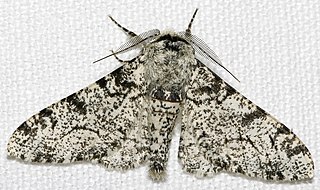
The Peppered Moth: Before (Picture taken by Olaf Leillinger)
The Peppered Moth: After (Picture taken by Olaf Leillinger)
Rather wonderfully, when the pollution finally subsided and the environment became paler again, the moths gradually changed back to their original color. Although this wasn’t a change of species into another it certainly demonstrated that the form of a species can change remarkably rapidly when the environment demands it.

Similar effects have been seen in fish, for instance the South American guppy, again with a fairly rapid change in their camouflage. As with the Peppered Moth camouflage is a great way of staying alive, or of being eaten by a predator if it fails, before you get a chance to pass on your genes.

What about humans? Are genetic mutations going on right now that might give some people an advantage? Certainyly. There’s a town called Limone sul Garda in Italy where a small proportion of the community have a mutated version of a protein that protects them against cardiovascular disease. They’ve even been able to trace the mutation back 300 years to the original “mutant”, a man called Giovanni Pomarelli. Drug companies are doing their best to make an artificial version of the protein that you and I can take. It’s either that or we send our children to that town in Italy to make babies with Signor Pomorelli’s descendants and get the gene into our family as well.

Sources

For a good introduction to evolution see the Wikipedia page here. That page contains a summary of Natural Selection but there's a fuller description here.

If you want to know more about the fruit fly see the Wikipedia page here. For details on their disease gene similarity to humans see here.

There's a very good summary of the evolution of the Peppered Moth here. Details of the micro-evolution of the South American guppy can be seen here and a profile of the biologist concerned, John Endler here.

Finally you can see details of the fascinating advantageous mutation in Italy here and here.

Saturday, October 08, 2011

Weekend Post - Faster than light?

There might be a revolution in science any moment now. Or maybe not.

A few weeks ago Italian scientists said that they thought they’d broken one of the fundamental laws of nature. They claimed that they had managed to force a beam of particles to travel faster than the speed of light. Admittedly only very slightly faster than light, but even a little bit would have been enough. Their beam of neutrinos had travelled all the way from the CERN laboratory in Geneva, a trip of 730km, across the border into Italy and they arrived 60 billionths of a second earlier than light would have covered the same distance. If this is true, if something really can travel faster than light, faster than 300,000 kilometers per second, then our understanding of the universe has been incomplete. After the results were announced the international media was full of headlines asking "Was Einstein wrong?"

If true, this won’t be the first time that a revolution like this has occurred in science. When Einstein first proposed his laws of relativity there was an enormous backlash against them because they contradicted the theories of Isaac Newton and the scientific establishment of the time couldn’t accept that. However, a few experiments later it was found that Einstein was right and that Newton was out-dated. Of course that doesn’t mean Newton’s theories and equations aren’t relevant, they still are in almost all circumstances. Engineers building bridges, scientists launching spacecraft, even soldiers firing guns all use Newton’s laws and they work just fine for them. It’s only in extreme circumstances that Newton’s laws stop working and Einstein’s have to be used instead.

What might have happened in Italy is something similar. Nobody is actually saying that Einstein’s theories were wrong, it’s just that they might have been only 99% correct, they might not explain everything, there might be things that his theories don’t predict or explain.

Or, and this is much more likely, the results from Italy might just be wrong. To their credit the Italian scientists have published their results and have given the international scientific community the opportunity to tear them to pieces. That’s the way the scientific process works. You have an idea, you test it, you publish your results and your colleagues do their best to find a flaw in what you’ve done. It’s not a competition, it’s just a rigorous way of testing ideas. Unlike supernatural belief systems, criticism and testing are welcomed as ways to get closer to the truth.

One of the least well understood aspects of the scientific method is that there’s a difference between facts and explanations. Gravity, for instance, is a fact. If you’re unsure, feel free to lean too far out of a top floor window and in the next few seconds you’ll be convinced. Similarly evolution is a fact. It’s been seen in a variety of quickly reproducing animals over several generations. It can be seen in fruit flies, moths and fish. These aren’t denied by anyone who has seen the facts. They don’t need any more proof. Things fall to the ground, planets are attracted to stars, animals gradually change their form to adapt to their environment over time.

What’s differs are the possible explanations. With gravity, Newton just proposed that there was an attraction between bodies but he couldn’t explain how that might happen, he just came up with rather wonderful equations to explain and predict it. But those ideas later turned out to be very slightly imperfect. That’s when Einstein came along with the idea that the structure of space and time was curved by matter. That was a better explanation of everything and filled the gaps in Newton’s explanation. A step forward. Likewise with evolution. Initially we were told that species didn’t naturally change, they were static. Then biologists began to notice what they called “speciation”, that what once identical species seemed to have changed their form to adapt to different environments. Everyone who’s seen the evidence agrees that species adapt over time, the evidence for that is clear. Then Darwin came along with his explanation, natural selection. So far, that’s the best explanation we have for the variety and adaptation of species, humans included. Maybe one day another scientist will come up with an improved explanation. So far there doesn’t seem to be a need, Darwin’s theory appears to be holding out perfectly well, just like Einstein’s.

That’s the wonderful thing about science. Whether the Italian results are right or wrong, scientists will be happy. If Einstein’s ideas continue to adequately explain things then we’re happy. If however, there’s something his theories can’t explain? Fantastic, the universe is even more marvelous and complex than we thought already.

Sources

There's a good summary of the experiment in Nature. You can see the reaction to this story by doing a Google search like this.

You can see a summary of Newton and his theories here and of Einstein here. The experiments by Sir Arthur Eddington that provided the first experimental support are discussed in Eddington's biography here.

For a summary of the scientific method see here. If you're feeling a bit more adventurous read this on Karl Popper and "empirical falsification" as the basis of science. Learn that and you understand it all.

For background on Darwin and natural selection as his explanation for evolution see here.